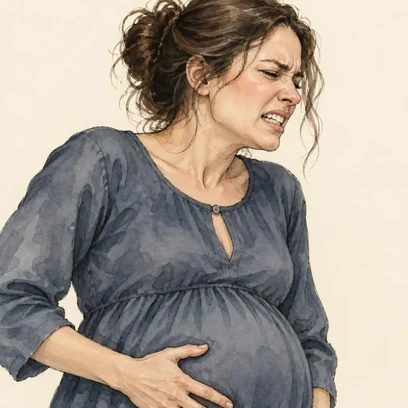
Abrupting Abby
Placental Abruption
Written lecture — video coming
The memory hook
Sudden pain + dark bleeding + rigid uterus — fetal distress races the clock
The story
Abby, 34 weeks and hypertensive, doubles over with sudden, constant abdominal pain after a minor car accident. Her belly feels hard as a board when her husband touches it.
Abby was an organized, fast-paced project manager who lived life on a strict schedule, never expecting an unforeseen catastrophe to disrupt her carefully planned world. At thirty-four weeks gestation, her life moved with punctual efficiency, yet her body held an underlying vulnerability that earned her the clinical moniker Abrupting Abby. The name reflected a sudden, violent separation waiting to unfold beneath the surface of her gravid abdomen. In placental abruption, the anchored lifeline of the placenta prematurely detaches from the decidua basalis of the uterine wall before delivery. This violent shearing tears maternal arterioles, cutting off critical perfusion and oxygen delivery to the fetus. Just as Abby's organized day was abruptly dismantled without warning, her placenta threatened to tear completely away from the muscular uterine bed.
Her crisis began on a rainy Tuesday morning during a routine commute. Abby managed chronic pre-existing hypertension throughout her pregnancy, already compromising the delicate microvasculature supplying the maternal-fetal interface. When another commuter struck her sedan at low speed, the lap portion of her seatbelt slammed violently across her lower abdomen, causing sudden deceleration trauma. Blunt abdominal impact and pre-existing vascular disease created the perfect tempest for vascular shearing. Other notorious culprits for abruption include cocaine use, smoking, advanced maternal age, and prior abruption. Abby initially dismissed the incident, but within an hour, a relentless, gnawing ache took hold across her lower belly. Unlike the intermittent, wave-like contractions of normal physiological labor, Abby's abdominal pain remained constant, intensifying steadily and refusing to relax for even a single second.
By the time triage wheelchaired Abby into labor and delivery, her condition had erupted into a full-scale obstetric crisis. Her abdomen was palpated as hypertonic, woody, and intensely board-like, remaining completely rigid between contractions. A trickle of dark, port-wine vaginal blood stained her gown, though her pale, diaphoretic skin and profound tachycardia signaled severe concealed hemorrhage trapped behind the placenta. The fetal monitor revealed fetal tachycardia at 170 beats per minute deteriorating into persistent late decelerations with absent variability. Critical diagnostic labs confirmed massive hidden trauma: her hemoglobin plunged to 8.2 g/dL, hematocrit dropped to 25 percent, and serum fibrinogen crashed to an alarming 130 mg/dL, warning of impending disseminated intravascular coagulation. Her Kleihauer-Betke test was positive, verifying extensive fetomaternal hemorrhage across the severed placental barrier.
The nurse moved rapidly to reverse fetal hypoxemia and stave off maternal circulatory collapse. Immediate priority interventions unfolded in strict sequence: the nurse placed Abby onto her left lateral side to relieve vena caval compression and applied ten liters per minute of oxygen via non-rebreather mask. The nurse established two large-bore 16-gauge intravenous lines, infusing rapid isotonic crystalloids while sending emergency blood for an immediate four-unit crossmatch. A digital vaginal examination was strictly contraindicated, as inserting an examining hand into unconfirmed uterine bleeding risks catastrophic hemorrhage if placenta previa is present. Continuous maternal hemodynamic assessment and continuous fetal monitoring ran unabated while the team mobilized the surgical suite. With maternal shock deepening and fetal heart tones plummeting, the nurse rushed Abby down the hall for an emergent cesarean section.
The setup
Abby has chronic hypertension and is involved in a low-speed car accident with a seatbelt across her abdomen.
The turn
She develops sudden, constant abdominal pain unrelieved by position change, unlike the intermittent cramping of labor.
The crisis
Her uterus becomes rigid and board-like, dark red blood appears, and the fetal monitor shows late decelerations with minimal variability.
The save
The nurse places her in a lateral position, applies oxygen, starts a large-bore IV, and calls for immediate emergency cesarean delivery as the team prepares blood products.
Already a member? Sign in