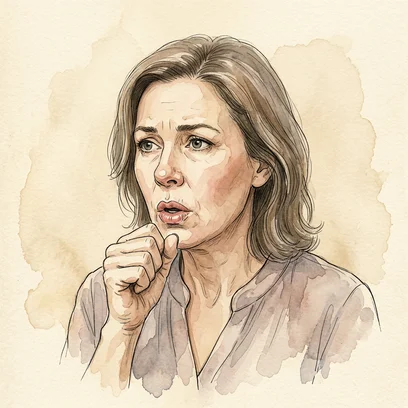
ACE Angie
ACE Inhibitors: Cough, Angioedema & Hyperkalemia
Written lecture — video coming
The memory hook
Lisinopril lowers her blood pressure beautifully — until the dry cough starts and her lips begin to swell
The story
Angie started lisinopril three weeks ago and her blood pressure is finally controlled, but now she cannot stop coughing — a dry, hacking tickle that keeps her up at night. This morning she notices her lips look swollen.
Angie earned her nickname on the walking track of her retirement community, where she recruits neighbors every morning for laps meant to keep her blood pressure in check. Diagnosed with hypertension in her fifties, she was started on lisinopril, one of the family of ACE inhibitors that block the conversion of angiotensin I into angiotensin II. That blockade relaxes her blood vessels and eases the workload on her heart, but the same enzyme she is suppressing also happens to break down bradykinin, a substance that otherwise gets quietly cleared from her tissues. With ACE blocked, bradykinin builds up in Angie's body, setting the stage for two very different complications: an irritating dry cough that many patients simply tolerate, and a much rarer, potentially airway-closing swelling that can strike without warning.
For nearly two years, Angie does beautifully on her lisinopril, her pressures running a steady 128 over 78, and she jokes to her walking group that the medication is the reason she can still keep pace with women half her age. She does mention, almost as an afterthought, a nagging dry tickle in her throat that has lingered for months, assuming it is simply seasonal allergies or the dry autumn air. Her daughter, a nursing student, urges her to bring it up at her next appointment rather than dismiss it, but Angie waves off the suggestion, more interested in finishing her crossword than worrying about a cough that never actually produces anything. That casual dismissal becomes far more consequential one otherwise ordinary Tuesday evening.
While finishing dinner, Angie suddenly notices her lips feel oddly thick and tingly, and within twenty minutes her tongue has visibly swollen enough that her words come out garbled and slurred. Her daughter rushes her to the emergency department, where the triage nurse documents rapidly progressing facial and tongue edema, a hoarse voice, and audible stridor beginning to creep into her breathing. Angie's oxygen saturation, a comfortable 97 percent just an hour earlier, has already slipped to 91 percent on room air. There is no rash, no hives, and no history of food exposure, which immediately points away from a typical allergic reaction and toward the specific, bradykinin-mediated angioedema that ACE inhibitors can trigger at any point in therapy, even after years of apparently safe use.
The emergency nurse recognizes instantly that this is not the time to wait and observe. She stops the lisinopril immediately and notifies the physician while simultaneously preparing airway equipment at the bedside, because angioedema of the tongue and airway can progress to complete obstruction within minutes rather than hours. She positions Angie upright to maximize airway diameter, applies supplemental oxygen, and anticipates the possibility of emergency intubation or even a surgical airway if swelling advances further. She documents the ACE inhibitor as the causative agent clearly in the chart, ensures Angie will never again be prescribed any drug in that class, and prepares patient education emphasizing that even a long-tolerated ACE inhibitor can suddenly cause life-threatening angioedema.
The setup
Angie is prescribed lisinopril for stage 2 hypertension and is told it will also protect her kidneys because she has diabetes.
The turn
Two weeks in, Angie develops a dry, nonproductive cough that is worse at night and does not respond to cough syrup.
The crisis
One morning Angie's lips and tongue begin to swell and her voice sounds muffled and thick.
The save
The nurse stops the lisinopril immediately, prepares for airway management, and the provider switches Angie to an ARB with instructions to never take an ACE inhibitor again.
Already a member? Sign in