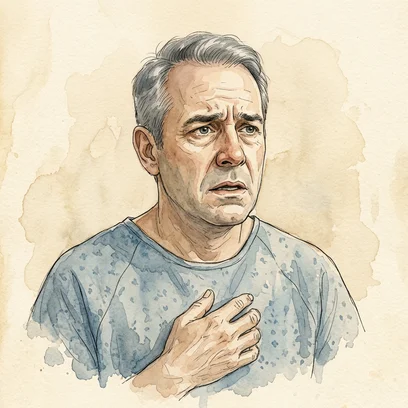
Ascending Abe
Guillain-Barré Syndrome: Weakness That Climbs Toward the Lungs
Written lecture — video coming
The memory hook
His tingling toes became weak legs, then a weak chest — the paralysis is climbing, and the only question that matters is his breathing
The story
Abe had diarrhea two weeks ago. Yesterday his legs felt heavy; today he cannot lift them, and the nurse is measuring his vital capacity every few hours.
Abe spent his career as a mountain guide, known affectionately as Ascending Abe for his tireless ability to climb steep switchbacks faster than clients half his age, always pushing upward without ever tiring. That identity built around relentless ascent becomes a cruel irony weeks after he recovers from a mild stomach virus, when a strange tingling begins creeping into his toes. Guillain-Barré syndrome is an autoimmune attack that follows a preceding infection, in which the body's antibodies mistakenly destroy the myelin sheath surrounding peripheral nerves. Because the damage begins distally and spreads inward and upward, weakness climbs Abe's body just as methodically as he once climbed mountain trails, starting in his feet and steadily ascending toward his trunk, arms and eventually the muscles that control his very breathing.
Abe is admitted to the neurology unit ten days after his gastrointestinal illness resolved, reporting that his legs feel increasingly like rubber and that he stumbled twice attempting to walk from his car to the clinic entrance. On examination, his deep tendon reflexes are entirely absent at both ankles and knees, a hallmark finding the admitting nurse recognizes immediately. A lumbar puncture is performed, and his cerebrospinal fluid reveals markedly elevated protein with a normal white blood cell count, the classic albuminocytologic dissociation seen in this disease. The care team places him on continuous cardiac monitoring, aware that autonomic instability often accompanies the ascending paralysis, and they begin measuring his vital capacity at baseline to establish a reference point before any further climbing weakness can threaten his respiratory reserve.
Over the following thirty-six hours, Abe's ascent accelerates alarmingly. His arms grow noticeably weaker, he struggles to lift a spoon to his mouth, and his voice takes on a breathy, effortful quality. His nurse performs serial vital capacity measurements every four hours and watches the number drop from 22 milliliters per kilogram down to just 13 milliliters per kilogram, crossing the critical threshold that signals impending respiratory failure. His blood pressure swings unpredictably between 88/54 and 162/98 within the same hour, reflecting the autonomic instability that so often accompanies this syndrome. When Abe begins coughing weakly after a sip of water and his oxygen saturation dips to 90 percent, the team recognizes his diaphragm and swallowing muscles are now caught in the same relentless ascent as everything below them.
The nurse escalates immediately rather than waiting for overt respiratory arrest. She notifies the physician of the falling vital capacity and prepares intubation equipment at the bedside well before Abe shows any visible gasping or cyanosis, understanding that Guillain-Barré respiratory failure can arrive with deceptive quiet. She holds oral intake given his weakening cough and swallow, requesting a swallow evaluation before allowing anything by mouth again. Plasmapheresis is initiated per the physician's order to hasten his recovery, and prophylactic anticoagulation is started given his profound immobility. Throughout every position change she moves slowly and monitors his blood pressure and heart rate closely, aware that his unpredictable autonomic nervous system can swing dangerously with something as simple as sitting him upright.
The setup
Two weeks after a stomach bug, Abe notices tingling in his toes and legs that feel like wet cement.
The turn
His knee and ankle reflexes are gone, his walking is unsteady, and the weakness is climbing toward his trunk.
The crisis
Abe's voice is softer and his cough is weak. His forced vital capacity is falling — the weakness is reaching the muscles of breathing.
The save
Abe starts IVIG, his breathing is monitored on a schedule, and rehabilitation begins early while his nerves slowly remyelinate.
Already a member? Sign in