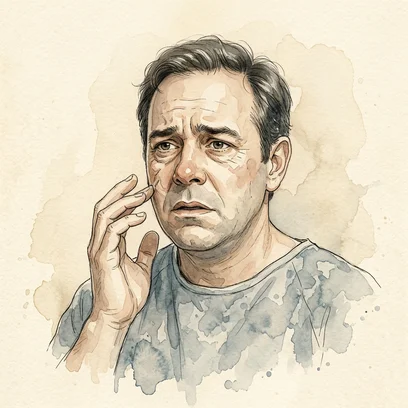
Chvostek Chuck
Hypocalcemia
Written lecture — video coming
The memory hook
Twitchy face, tingling lips, watch the airway
The story
Chuck wakes from thyroid surgery with a buzzing lip and a cheek that jumps when the nurse taps it. His parathyroids took the hit, and now every nerve in his body has its volume turned up.
Chuck Vance is an energetic high school drama coach who talks with his hands, wears bold patterned vests, and prided himself on animated expressions. His stage nickname, Chvostek Chuck, originally poked fun at his habit of twitching his cheek to signal dramatic tension to the backstage crew. Beneath the theater lights, Chuck's physiological stability relied entirely on normal mineral regulation, but his nerves have recently turned hyper-excitable. In hypocalcemia, low extracellular calcium destabilizes neuronal membranes, allowing sodium to rush freely across axonal channels and lower the threshold for depolarization. Instead of keeping peripheral nerves properly insulated and calm, his depleted calcium levels turn up the volume on every electrical circuit. Chuck's body is primed for sudden, uncontrollable firings, transforming his signature dramatic facial quirks into a dangerous systemic neuromuscular storm.
Chuck's journey toward metabolic crisis began thirty-six hours ago following a total thyroidectomy for a toxic multinodular goiter. While removing his thyroid gland, the surgical team accidentally bruised and devascularized his tiny parathyroid glands, which drastically reduced parathyroid hormone output. Without parathyroid hormone to stimulate renal resorption, bone turnover, and intestinal activation of vitamin D, his bloodstream rapidly depleted its circulating calcium pool. Risk factors like postoperative surgical trauma, chronic kidney disease, or rapid blood transfusions with citrate preservatives all pave the path to acute drops. Late during night shift, Chuck noticed subtle, odd sensations he initially dismissed as postoperative nervousness. His lips began buzzing like tiny bees hovered on his skin, accompanied by persistent numbness and circumoral tingling. Soon, similar pins-and-needles paresthesias crept through his fingertips, signaling that hypocalcemia was silently tightening its grip.
By dawn, Chuck’s irritable nerves crossed into full-blown tetany. When the nurse gently tapped his facial nerve just anterior to the ear, his entire left cheek instantly winced into a violent spasm, demonstrating a classic positive Chvostek’s sign. Inflating a blood pressure cuff on his upper arm immediately triggered painful carpal spasm, forcing his wrist and fingers into involuntary flexion known as Trousseau’s sign. His patellar reflexes were wildly brisk, and deep muscle cramps seized his calves. Worse, Chuck let out a high-pitched, crowing gasp as laryngospasm constricted his vocal cords. Emergency laboratory draws confirmed a perilous total serum calcium of 6.8 mg/dL, well beneath the normal floor of 8.5 mg/dL, with a critically low ionized calcium fraction. The twelve-lead electrocardiogram revealed significant QT interval prolongation, heralding fatal ventricular dysrhythmias and impending arrest.
The nurse acted swiftly, prioritizing Chuck’s threatened airway by calling for rapid assistance, positioning him upright, and immediately bringing an emergency tracheostomy tray and suction directly to the bedside. The primary medical intervention was intravenous calcium gluconate, administered slowly through a dedicated line under continuous cardiac monitoring. Rapid bolus administration was strictly contraindicated because rushing the infusion carries a high risk of profound bradycardia, hypotension, and cardiac standstill. The nurse also implemented strict seizure precautions, placed padded side rails, and dimmed the room lights to prevent sensory stimulation from triggering generalized convulsions. Throughout the slow infusion, the nurse continuously watched the rhythm strip for narrowing of that elongated QT interval, checked serum magnesium levels for concurrent deficits, and reassessed Chuck’s respiratory effort until his crowing stridor finally subsided into soft, unlabored breathing.
The setup
A total thyroidectomy leaves his parathyroid glands bruised and underperforming.
The turn
He reports tingling around his mouth and in his fingertips overnight.
The crisis
His cheek twitches when the nurse taps his facial nerve, his hand claws under the cuff, and then his voice turns high and crowing.
The save
IV calcium gluconate is pushed slowly on a monitor, with a tracheostomy tray at the bedside.
Already a member? Sign in