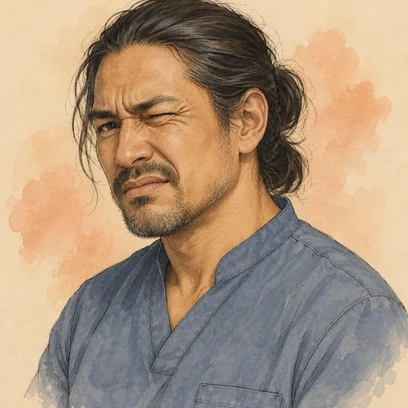
Clotted Cliff
Deep Vein Thrombosis & VTE Prevention
Written lecture — video coming
The memory hook
Unilateral calf swelling, warmth, and a positive Homans-like tenderness — never massage the leg, a clot may already be loose
The story
Three days after hip surgery, Cliff's right calf becomes swollen, warm, and tender to touch, and he suddenly develops sharp pleuritic chest pain and shortness of breath while the nurse is assessing him.
Cliff spent his entire career as a river barge captain, nicknamed Clotted Cliff by his crew for his uncanny ability to predict exactly where floating debris would accumulate and clog narrow river channels during seasonal flooding. That professional talent for anticipating dangerous blockages now describes his own postoperative circulatory system with unsettling accuracy. Following hip replacement surgery, prolonged immobility, vessel wall trauma from the procedure itself, and an inherent postsurgical hypercoagulable state combined perfectly to form Virchow's classic triad, creating ideal conditions for a venous thrombus to silently accumulate within the deep veins of his calf, much like debris slowly clogging a river channel he once expertly navigated.
Three days after undergoing elective hip replacement surgery, Cliff remained largely confined to his hospital bed, his sequential compression devices removed intermittently for physical therapy sessions and never consistently reapplied afterward by busy staff. He assumed the mild discomfort in his right calf was simply normal postoperative soreness from the surgical positioning and diminished mobility. Nobody initially noticed that his right calf had grown visibly larger than his left, nor that the surrounding skin had become subtly warmer to the touch. Cliff's incisional pain masked the developing deep venous thrombosis quietly forming within his soleal venous sinuses, undetected during routine postoperative rounds.
By the third postoperative day, Cliff's right calf had become unmistakably swollen, warm, and tender along its posterior aspect, prompting his nurse to measure and compare bilateral calf circumferences, finding a three-centimeter discrepancy. While the nurse was documenting these findings and preparing to notify the surgical team, Cliff suddenly clutched his chest, gasping that he could not catch his breath. His oxygen saturation plummeted to eighty-eight percent, he described sharp, stabbing pleuritic chest pain, and his heart rate accelerated to one hundred twenty-two beats per minute, all hallmark signs that a fragment of his deep venous clot had dislodged and traveled directly into his pulmonary circulation.
The nurse immediately maintained Cliff on strict bed rest, deliberately avoiding any manipulation or massage of his swollen calf that could dislodge additional clot fragments into his bloodstream. Supplemental oxygen was applied immediately, the head of his bed was raised to optimize ventilation, and the rapid response team was activated for emergent evaluation. A CT pulmonary angiogram confirmed multiple bilateral pulmonary emboli, and Cliff was started on a weight-based intravenous heparin infusion, with the nurse closely monitoring his activated partial thromboplastin time every six hours to ensure therapeutic anticoagulation while continuously watching his oxygenation and hemodynamic stability throughout his critical care admission.
The setup
Cliff underwent hip replacement surgery and has been largely immobile in bed for three days without his sequential compression devices consistently applied.
The turn
Cliff's right calf becomes visibly swollen compared to the left, warm to touch, and tender along the posterior calf.
The crisis
While being assessed, Cliff suddenly develops sharp pleuritic chest pain, shortness of breath, and his oxygen saturation drops to 88%.
The save
The nurse immediately keeps Cliff on strict bed rest without massaging the leg, raises the head of the bed, applies supplemental oxygen, and notifies the provider for emergent imaging and anticoagulation.
Already a member? Sign in