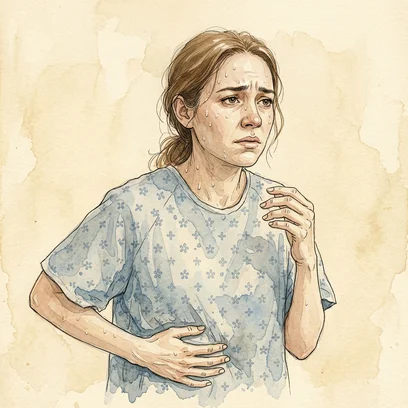
Ectopic Erica
Ectopic Pregnancy: The Pain on One Side and the Shoulder That Screams Rupture
Written lecture — video coming
The memory hook
Missed period, one-sided pain, spotting — then shoulder pain means it has burst
The story
One missed period, pain on one side, a little spotting — and the moment her shoulder starts to ache, Erica knows the tube has burst.
Erica earned her nickname on the debate team, where classmates joked she always argued from an unexpected angle, never taking the obvious position when a sideways one would land harder. That habit of settling somewhere it should not be becomes tragically literal when Erica, now twenty-six, conceives and the fertilized ovum implants not in her uterine cavity but inside her narrow, unyielding fallopian tube. A tube has none of the uterus's capacity to stretch and grow, so as the pregnancy expands it distends the tube from within, producing unilateral pain and light spotting long before anyone suspects the true danger. Left undiagnosed, the tube will eventually rupture, spilling blood into the peritoneal cavity and turning a quiet gynecologic complaint into a surgical emergency within minutes. Erica's sideways nickname becomes the exact clue to remember where this pregnancy has gone.
Erica arrives at the emergency department five weeks after a missed period, describing crampy, aching pain low on her right side that has been building for two days along with scant brown spotting. She mentions a prior episode of pelvic inflammatory disease treated two years earlier, a detail the triage nurse immediately recognizes as a major risk factor for tubal scarring and ectopic implantation. Her urine pregnancy test is positive, but her quantitative hCG level is rising more slowly across serial draws than would be expected for a healthy intrauterine pregnancy. The emergency physician orders an urgent transvaginal ultrasound, suspecting that the pregnancy is not where it belongs, while Erica, still ambulatory and only mildly uncomfortable, has no idea that her tube is already dangerously distended and close to giving way.
Within the hour, Erica's right-sided pain sharpens abruptly into a severe, tearing sensation, and she suddenly clutches her right shoulder, wincing as new pain radiates upward with every breath. Her blood pressure drops to 88/54 mmHg, her heart rate climbs to 122 beats per minute, and she becomes visibly pale and diaphoretic before briefly losing consciousness on the stretcher. Her hemoglobin, drawn on repeat labs, has fallen from 12.8 to 9.6 g/dL in under two hours, confirming active internal hemorrhage. The referred shoulder pain is diaphragmatic irritation from blood pooling under the diaphragm in the peritoneal cavity, an unmistakable sign that the tube has ruptured and Erica is now in hypovolemic shock from unseen abdominal bleeding rather than any visible external wound.
The nurse responds instantly, recognizing shoulder pain with a positive pregnancy test as rupture until proven otherwise. She establishes two large-bore intravenous lines, sends stat labs for type and crossmatch, and begins rapid isotonic fluid resuscitation while paging the obstetric surgical team for emergency exploratory surgery. She positions Erica flat with legs elevated, applies supplemental oxygen, and monitors vital signs continuously, anticipating further deterioration before the operating room is ready. Because Erica is Rh-negative, the nurse confirms that Rho(D) immune globulin is ordered for after stabilization. Throughout, she offers calm reassurance and prepares Erica emotionally for the loss of the pregnancy, knowing that grief support belongs alongside every lifesaving intervention in this unfolding crisis.
The setup
A client reports a missed period, mild left-sided pelvic pain and light spotting.
The turn
Her hCG is rising, but far more slowly than a normal pregnancy, and ultrasound shows an empty uterus.
The crisis
She suddenly reports sharp shoulder pain, feels faint, and her blood pressure is dropping.
The save
Erica moves fast: large-bore IV access, blood type and crossmatch, and straight to surgery.
Already a member? Sign in