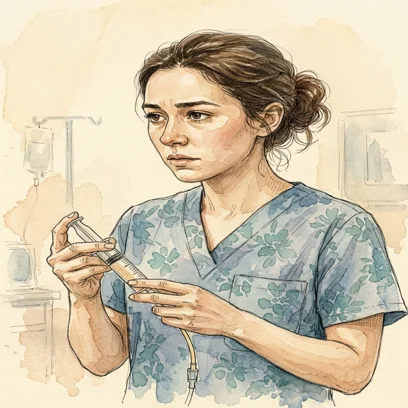
Feeding Fiona
Enteral Feeding & Aspiration Prevention: Head of Bed Up, Placement Verified
Written lecture — video coming
The memory hook
One flat-lying tube feeding is all it takes to turn nutrition into pneumonia
The story
Fiona's tube feeding is running while she lies flat because she slid down in bed. She starts coughing, and her oxygen saturation dips.
Fiona is a former nutrition teacher known for decades of classroom lessons on balanced meals, now relying entirely on enteral tube feedings after a severe stroke left her with an unsafe swallow and a persistent risk of aspiration. Her nickname, once a playful nod to her career, becomes a serious clinical reminder once her care team places a nasogastric feeding tube to deliver the nutrition her body still needs despite her inability to safely eat by mouth. Enteral formula delivered into a stomach that cannot empty properly, or through a tube that has migrated from its intended position, can reflux upward into the pharynx and then be silently aspirated into the lungs. Gastric contents landing in lung tissue cause immediate chemical injury followed by pneumonia, which is precisely why positioning and placement verification anchor every safe feeding protocol Fiona's nurses follow.
Fiona is admitted to a rehabilitation facility where her feeding schedule runs four times daily through her nasogastric tube, and her care plan explicitly specifies that her head of bed must remain elevated between 30 and 45 degrees during and for a full hour after each feeding. One overnight shift, an exhausted nursing assistant, rushing between several clients, repositions Fiona flat on her back to change her linens immediately after her overnight feeding infuses, intending to elevate her again momentarily but becoming distracted by another client's call light down the hall. Fiona, unable to speak clearly or call out effectively due to her stroke-related deficits, remains flat for nearly forty minutes with a stomach full of recently administered formula.
When the primary nurse returns to check on Fiona, she immediately notices a subtle wet, gurgling quality to Fiona's breathing that was absent during the earlier assessment, along with a new, weak cough that produces small amounts of formula-tinged secretions. Fiona's oxygen saturation has dropped from her baseline of 97 percent down to 90 percent, and her respiratory rate has climbed to 24 breaths per minute with faint crackles now audible at her right lung base. These findings strongly suggest that formula has already been silently aspirated during the period she spent lying flat, and the right lower lobe crackles specifically reflect the anatomic tendency for aspirated material to settle into that dependent lung segment.
The nurse immediately stops the current feeding, though it had already finished infusing, and elevates Fiona's head of bed to 45 degrees at once to reduce further reflux risk. She suctions Fiona's oropharynx gently to clear visible secretions and notifies the provider promptly, anticipating orders for a chest x-ray to evaluate for aspiration pneumonia and possibly for oxygen support given the desaturation. She documents the incident thoroughly, including the exact duration Fiona spent lying flat, and she uses this near-miss to reinforce firmly with the entire care team, especially the nursing assistant, that head-of-bed elevation during and after feedings is never optional or something to postpone, even briefly, for another task.
The setup
After a stroke, Fiona fails her swallow screen and a feeding tube is placed for nutrition.
The turn
She slides down in bed and the feeding keeps running with her nearly flat.
The crisis
Fiona coughs, her voice sounds wet, and her oxygen saturation falls.
The save
The feeding is stopped, she is repositioned upright, placement and residual are rechecked, and the tube is flushed before restarting.
Already a member? Sign in