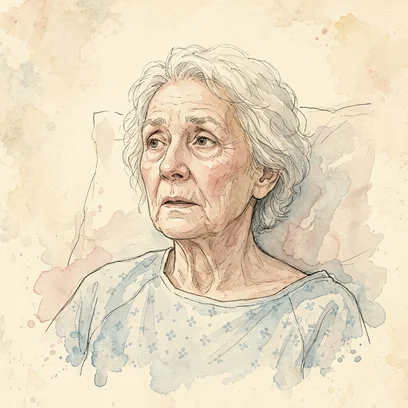
Fractured Frida
Hip Fracture & Fat Embolism: The Shortened Leg and the Confusion That Follows
Written lecture — video coming
The memory hook
Her leg is shorter and turned outward after the fall — and two days later her confusion is not from the pain medicine
The story
Frida's right leg looks shorter than her left and her foot rolls outward. Her repair goes well — but on day two she stops making sense.
Frida spent her whole life as a devoted ballroom dance instructor, celebrated for her flawless posture and nicknamed Fractured Frida only in her later years, after a slip on an icy sidewalk sent her tumbling and left her with a broken hip that finally interrupted decades of graceful, upright movement. A hip fracture disrupts the powerful muscles surrounding the joint, and their unopposed pull characteristically shortens the injured leg and rotates it externally, a visible deformity any nurse should recognize instantly. But the fracture itself is only the beginning of Frida's danger, because marrow fat trapped inside the broken bone can escape into her venous circulation and travel to her lungs and brain, a phenomenon called fat embolism syndrome that classically emerges 24 to 72 hours after a long bone or hip fracture just like hers.
Frida undergoes surgical repair of her hip fracture within 36 hours of her fall, and her early postoperative course seems reassuringly uneventful. She is alert, cooperative with physical therapy, and her incision looks clean and well-approximated. Her nurse carefully positions her with an abduction pillow between her legs, keeping her hip flexion limited to well under 90 degrees per standard hip precaution protocol, and reinforces that she must never cross her legs or twist at the hip while healing. Frida jokes with the physical therapist about finally getting to rest her dancing feet, and everyone on the unit expects her recovery to proceed smoothly toward eventual discharge to a rehabilitation facility within the coming days.
On the second postoperative day, exactly within the classic window for this complication, Frida's nurse notices something is wrong during a routine assessment. Frida seems unusually confused, calling her nurse by her late husband's name and struggling to state what day it is, despite having been perfectly oriented the evening before. Her oxygen saturation has dropped to 88 percent on room air, prompting immediate supplemental oxygen, and a fine, red-purple petechial rash has appeared scattered across her chest and both axillae. Her respiratory rate climbs to 28 breaths per minute, and she appears visibly anxious and restless. This unmistakable triad of new hypoxemia, acute neurologic change, and a petechial rash confirms fat embolism syndrome, not simply the sedating effect of her postoperative pain medication as the covering physician initially assumed.
Frida's nurse immediately escalates rather than accepting a reassuring explanation for the confusion. She applies supplemental oxygen, elevates the head of the bed, and notifies the physician urgently of the new hypoxemia, mental status change and rash together, insisting this combination cannot simply be attributed to opioid sedation. She continues frequent neurologic checks and closely monitors his oxygen saturation trend while awaiting further diagnostic workup and respiratory support. She maintains strict hip precautions throughout, keeping the operative leg abducted and avoiding any flexion beyond 90 degrees during every repositioning, and ensures prophylactic anticoagulation continues on schedule given Frida's markedly elevated risk for venous thromboembolism during this period of reduced mobility following her fracture repair.
The setup
Frida tripped on a rug. Her right leg is shortened and externally rotated and she cannot bear weight.
The turn
After surgical repair, Frida learns her new rules: no bending past 90 degrees, no crossing her legs, abduction pillow in place.
The crisis
On post-op day two, Frida is suddenly restless and confused, her oxygen saturation falls, and tiny red spots appear on her chest.
The save
The nurse applies oxygen, raises the head of the bed and calls the provider. Frida's confusion clears as her oxygenation recovers.
Already a member? Sign in