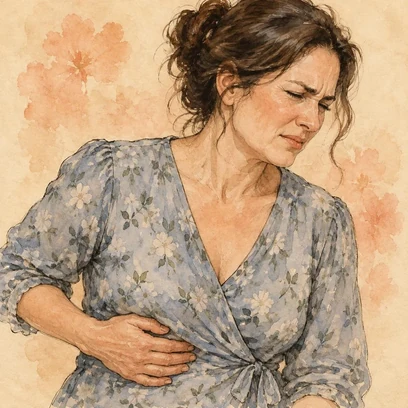
Gallstone Gina
Cholecystitis & Cholelithiasis
Written lecture — video coming
The memory hook
RUQ pain after a fatty meal, radiating to the right shoulder — a positive Murphy's sign clinches it
The story
Gina doubles over an hour after a plate of fried chicken, clutching her right upper abdomen as the pain radiates up toward her shoulder blade. When the nurse presses under her ribs during a deep breath, Gina gasps and stops breathing mid-inhale.
Gina runs a small catering business specializing in decadent, butter-laden comfort food, and her friends jokingly call her Gallstone Gina because she never turns down a second helping of fried chicken or creamy sauce. That nickname carries an uncomfortable prophecy hidden within her own biliary tree. Deep inside her gallbladder, cholesterol-saturated bile has been slowly crystallizing into hardened gallstones for years, a process accelerated by her demographic risk profile of being female, over forty, and carrying extra weight. Whenever she eats a rich, fatty meal, her gallbladder contracts forcefully in response to cholecystokinin release, squeezing bile toward the duodenum, but this time a stone becomes firmly wedged within her narrow cystic duct, trapping bile inside an increasingly inflamed, distended organ.
The trouble erupts after Gina caters an evening wedding reception and personally samples an enormous plate of fried chicken and buttery mashed potatoes backstage. Roughly an hour later, a steady, gnawing ache develops beneath her right ribcage, radiating unmistakably toward her right shoulder blade. She initially dismisses it as simple overindulgence, popping antacids that provide no relief whatsoever. As the night wears on, nausea overtakes her, and she vomits twice while doubled over the kitchen sink. The pain refuses to subside with rest or position changes, steadily intensifying instead of the typical fleeting spasm she has experienced from smaller gallstones passing painlessly in the past.
By the time Gina arrives at the emergency department, her temperature has climbed to 101.8 degrees Fahrenheit, and she winces sharply, catching her breath mid-inhalation the moment the examining physician presses beneath her right costal margin, a textbook positive Murphy's sign. Laboratory results reveal an elevated white blood cell count along with rising alkaline phosphatase and bilirubin levels, and the nurse notices Gina's sclera have taken on a faint yellowish tinge. Her urine appears unusually dark, while her most recent bowel movement was strikingly pale and clay-colored, worrying signs that a stone has migrated further downstream and is now obstructing her common bile duct rather than merely the cystic duct.
The nurse immediately places Gina on strict nothing-by-mouth status to rest her inflamed gallbladder completely, initiates intravenous fluids for hydration, and administers prescribed analgesics and antiemetics to control her escalating symptoms. Serial monitoring of her bilirubin, liver enzymes, and vital signs continues closely, watching vigilantly for any signs of ascending cholangitis such as spiking fevers, rigors, or worsening jaundice. An urgent right upper quadrant ultrasound confirms multiple gallstones along with a thickened gallbladder wall. Recognizing acute cholecystitis with possible common bile duct involvement, the surgical team schedules Gina for a laparoscopic cholecystectomy, definitively removing the diseased gallbladder before rupture or life-threatening cholangitis can develop.
The setup
Gina, a middle-aged woman with a history of fatty food intolerance, develops intermittent RUQ discomfort after meals.
The turn
After a large fatty dinner, steady, severe RUQ pain develops, radiating to her right scapula, with nausea and vomiting.
The crisis
Gina's temperature rises to 38.9°C, she has a positive Murphy's sign, and her sclera begin to look faintly yellow with dark urine and pale stools.
The save
The nurse keeps Gina NPO, maintains IV fluids and antiemetics, monitors for worsening jaundice or rising bilirubin, and prepares her for an ultrasound and likely laparoscopic cholecystectomy.
Already a member? Sign in