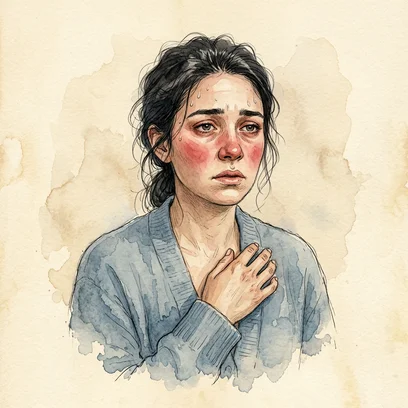
Mastitis Mabel
Mastitis: Flu-Like Fever, a Red Wedge & Keep Nursing
Written lecture — video coming
The memory hook
A hot red wedge on one breast and a 102 fever — and the treatment is to keep breastfeeding, not stop
The story
Ten days postpartum, Mabel wakes with chills, a 102 fever and body aches. Her left breast has a hot, hard red wedge, and she asks if she must stop nursing.
Mabel earned her nickname from the lactation consultants at her postpartum support group, who watched her power through cracked, painful nipples in her determination to exclusively breastfeed her newborn no matter the discomfort. That persistence, admirable as it was, left a tiny fissure in her skin that became the entry point for Staphylococcus aureus, the bacteria most often responsible for mastitis, an infection and inflammation of breast tissue. Missed and incomplete feedings during a stressful week caused milk to pool and stagnate in one section of her breast, providing exactly the medium bacteria need to flourish. Mabel's name is a memorable anchor for the lesson that mastitis is typically unilateral, arising where cracked skin and milk stasis intersect, and that the treatment paradoxically requires continuing rather than stopping breastfeeding.
Three weeks postpartum, Mabel wakes shivering under three blankets despite a warm bedroom, aching all over as though she has caught the flu. When her partner checks her temperature it reads 101.8°F, and she notices a firm, tender, wedge-shaped area of redness radiating across the upper outer portion of her left breast. She initially assumes she is simply exhausted from nighttime feedings and considers skipping a session on that side to let it rest, reasoning that emptying an already painful breast sounds unbearable. Her nurse, reached by phone through the postpartum hotline, immediately recognizes this combination of unilateral wedge-shaped redness and flu-like systemic symptoms as the hallmark presentation of mastitis rather than ordinary breast engorgement.
By the time Mabel is seen in clinic the next morning, her temperature has climbed to 102.4°F with a shaking chill, and the wedge-shaped area has grown warmer, harder, and more clearly demarcated, now roughly the size of her palm. She reports that the affected breast feels like a swollen, painful rock and that even light clothing brushing against it is excruciating. The provider notes no fluctuant, pus-filled pocket yet, ruling out abscess for now, but emphasizes that if these symptoms fail to improve within 48 hours, an abscess or resistant organism must be suspected. Mabel is started on an antistaphylococcal antibiotic and instructed firmly that stopping breastfeeding now would only worsen the underlying milk stasis driving her infection.
The nurse's central priority is reinforcing that continued emptying of the affected breast through breastfeeding or pumping is a therapeutic necessity, not an optional comfort measure Mabel can skip. She teaches Mabel to apply a warm compress or take a warm shower just before feeding to encourage let-down, followed by a cool compress afterward to ease pain and swelling. She emphasizes completing the entire prescribed antibiotic course even once Mabel starts feeling better within a day or two, since stopping early risks recurrence or resistance. She also addresses the original entry point directly, teaching topical nipple care and correct latch technique to heal the cracked skin and prevent the infection from recurring in future feedings.
The setup
Mabel's nipples cracked early, and this week the baby slept through two night feedings on the same side.
The turn
She develops chills, aching muscles and a temperature of 102 F, and assumes she has the flu.
The crisis
Her left breast has a firm, red, hot wedge-shaped area, and she stops nursing on that side because it hurts.
The save
Mabel takes the full antibiotic course, continues breastfeeding and pumping to empty the breast, applies warmth before feeding, rests and increases fluids.
Already a member? Sign in