Osteo Opal
Osteoporosis: Silent Bone Loss, Fall Prevention & Bisphosphonates
Written lecture — video coming
The memory hook
She lost two inches of height and never felt a thing — until a hug fractured a vertebra
The story
Opal is 74 and has shrunk two inches since her last physical. Her daughter hugged her firmly last week, and now her mid-back aches constantly — an x-ray shows a compression fracture.
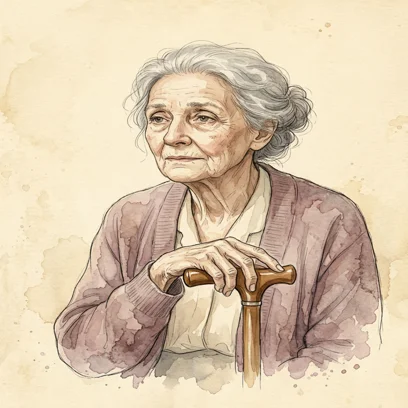
Opal spent her whole life as a graceful, upright ballroom dance instructor, admired for the perfect posture she demanded of every student, which is exactly why friends nicknamed her Osteo Opal once time began quietly working against her own spine. Bone is living tissue in constant turnover, and after menopause removed the protective restraint estrogen once placed on osteoclast activity, Opal's bone resorption began steadily outpacing new bone formation. Her vertebrae, hips and wrists grew thinner and more porous year after year, though the process itself caused her no pain whatsoever. That silence is the cruelest feature of osteoporosis: a woman who once stood taller than anyone in the room can lose real structural integrity in her skeleton without a single symptom warning her it is happening.
At her granddaughter's wedding, Opal receives an enthusiastic, tight embrace from an old dance student, and something in her upper back gives way with a small, sharp crack she barely registers over the music. She dismisses it as a muscle strain and finishes the reception, but by the next morning she cannot straighten fully upright and measures herself against the doorframe she has marked every year since childhood, discovering she has lost a full two inches of height compared to just last year. Her primary care provider orders a DEXA scan after hearing this history, deeply concerned that a routine hug should never be forceful enough to injure a healthy spine.
The scan reveals a T-score of negative 3.1, confirming established osteoporosis, and imaging of her thoracic spine shows an acute compression fracture at T8 with new kyphotic curvature already visible on her lateral X-ray. Opal reports the back pain has intensified to an 8 out of 10 despite scheduled analgesics, and she now walks noticeably stooped forward, unable to fully extend her spine. Her calcium intake, she admits under questioning, has been minimal for years, and she has never taken a vitamin D supplement. The provider recognizes this fracture as exactly the kind of fragility fracture that defines symptomatic osteoporosis, occurring from forces a normal vertebra would easily withstand.
The nurse's priorities center on preventing the next fracture rather than merely treating this one. She teaches Opal to take her newly prescribed oral bisphosphonate on an empty stomach with a full glass of plain water, then remain upright for a full 30 minutes afterward to prevent esophageal irritation. She ensures calcium and vitamin D supplementation begins immediately in appropriately divided doses for maximal absorption, and she performs a thorough fall-risk assessment of Opal's home, recommending removal of loose throw rugs, addition of grab bars, and better nighttime lighting throughout her hallways. She also reinforces gentle weight-bearing exercise for bone stimulation while firmly cautioning against any high-impact activity, bending, or twisting that could compress her fragile vertebrae further.
The setup
Opal is a thin, postmenopausal white woman who smokes, drinks little milk, and has never done weight-bearing exercise.
The turn
At her checkup she is two inches shorter than recorded, with a rounded upper back and a DEXA T-score of -2.8.
The crisis
A firm hug leaves Opal with sharp mid-back pain — imaging shows a new vertebral compression fracture.
The save
Opal starts alendronate with careful teaching, calcium and vitamin D, resistance walking, and a full home fall-safety sweep.
Already a member? Sign in