Overloaded Olive
Fluid Volume Overload: Crackles, Bounding Pulse & Stop the Infusion
Written lecture — video coming
The memory hook
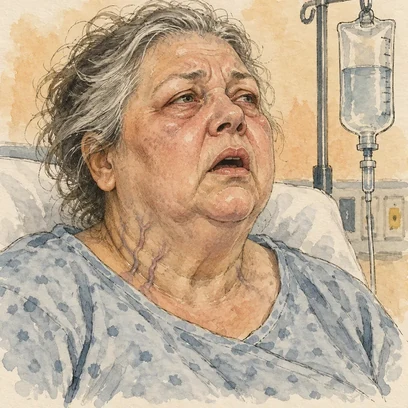
The IV ran wide open, and now she is coughing pink froth with veins standing out in her neck
The story
Olive's IV was left at a high rate overnight. By morning she has gained 3 kg, her neck veins bulge, and crackles fill both lung bases.
Olive picked up her nickname from her fellow nurses after a memorable shift when an infusion pump malfunctioned and ran an entire liter of normal saline into her elderly client in under an hour, a mistake that vividly illustrated exactly the condition she would later develop herself following major surgery. Fluid volume overload occurs whenever intake or retention exceeds what the heart and kidneys can actually handle, whether from rapid infusion, heart failure, kidney failure, or excess sodium intake. As circulating volume rises and venous pressure climbs, hydrostatic pressure forces fluid out of the capillaries into surrounding tissue and eventually into the alveoli themselves. Olive's name became an ironic, permanent reminder among her colleagues that overload can happen astonishingly fast, and that recognizing it early prevents a straightforward IV order from becoming a genuine emergency.
Days after her own hip replacement surgery, Olive is recovering on the orthopedic unit when a new nursing graduate, distracted during a busy shift change, accidentally leaves her postoperative IV line running wide open instead of at the prescribed maintenance rate. Over the following ninety minutes, nearly a liter and a half infuses into Olive's veins far faster than her recovering body, still adjusting from surgical fluid shifts, can accommodate. Olive begins to feel unusually short of breath while simply lying flat in bed, and she asks repeatedly for extra pillows to prop herself higher, a request her nurse recognizes immediately as a meaningful red flag rather than simple postoperative discomfort.
Within the hour, Olive is coughing up thin, pink-tinged frothy sputum, and her neck veins stand out prominently even while she sits upright in bed. Her pulse feels remarkably strong and bounding at 118 beats per minute, and crackles are audible in both lung bases when her nurse auscultates her breath sounds. Her weight, checked against yesterday's baseline, has climbed by 1.8 kilograms in under two hours, far exceeding the threshold that should prompt urgent concern. Her oxygen saturation has fallen to 89 percent on room air, and her repeat labs reveal a diluted sodium of 132 mEq/L alongside a urine specific gravity of 1.008, both consistent with acute fluid overload rather than any new cardiac event.
Olive's nurse immediately slows and then stops the malfunctioning infusion, keeping the line open only at the minimum rate needed per protocol rather than continuing the runaway rate. She positions Olive in high Fowler's position to ease her breathing and applies supplemental oxygen to correct her falling saturation. She notifies the provider promptly, anticipating an order for a loop diuretic such as furosemide, and monitors Olive's potassium closely once diuresis begins. She continues tracking Olive's daily weight, intake, and output meticulously, recognizing that weight trends will reveal the true trajectory of her fluid status far more reliably than any single lab value drawn in isolation during this acute overload episode.
The setup
Olive, 78 with heart failure, is admitted for dehydration and IV fluids are started at a generous rate.
The turn
By morning she has gained 3 kilograms, her pulse is bounding, and her blood pressure is up.
The crisis
Olive becomes short of breath, sits bolt upright, and crackles are audible in both lung bases with a moist cough.
The save
The nurse slows the infusion to keep the vein open, raises the head of the bed, applies oxygen, notifies the provider and gives the ordered furosemide, then tracks weight and output.
Already a member? Sign in