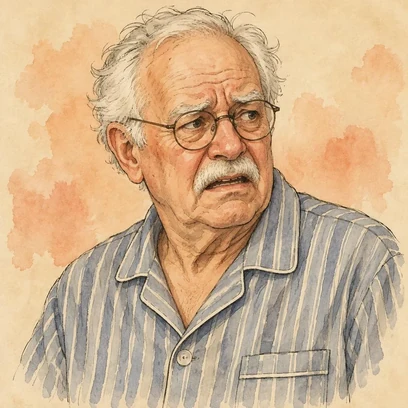
Prostate Percy
BPH & TURP Care
Written lecture — video coming
The memory hook
Bright red urine with clots post-TURP is expected briefly — watch for bladder spasms and clot retention
The story
Percy has struggled for months with a weak urine stream and getting up three times a night to void, so his TURP finally seemed like relief. Now, hours after surgery, his bladder feels tight and painful, and the drainage bag has stopped filling despite his irrigation running wide open.
Percy managed a bustling municipal water treatment plant for over three decades, meticulously monitoring every pipe, valve, and flow rate to ensure nothing ever became obstructed or backed up, earning him the fond nickname Prostate Percy among his engineering colleagues. That plumbing-obsessed nickname now describes an obstruction developing within his very own urinary plumbing system. As Percy aged, his prostate gland gradually enlarged through benign prostatic hyperplasia, progressively compressing his urethra exactly as an encroaching pipe restriction narrows water flow, producing hesitancy, a persistently weak stream, and the frustrating sensation that his bladder never fully empties no matter how long he lingers at the urinal.
For nearly two years, Percy struggled increasingly with urinary hesitancy, requiring him to wait uncomfortably long moments before his stream would finally begin, followed by a persistently weak flow that seemed to trickle rather than flow normally. He found himself waking three or four times nightly to urinate, severely disrupting his sleep and daytime energy levels. After exhausting conservative medical management options, Percy's urologist recommended a transurethral resection of the prostate, a surgical procedure to remove obstructing prostatic tissue through the urethra itself without requiring any external surgical incision, promising Percy relief from his years of frustrating urinary obstruction.
Following his TURP procedure, Percy returned to the recovery unit with a specialized three-way indwelling catheter connected to continuous bladder irrigation, designed specifically to flush blood clots and tissue debris away from his surgical site before they could accumulate and obstruct outflow. Initially, his irrigation drainage appeared appropriately light pink, exactly as expected during the first postoperative day. However, several hours later, Percy suddenly experienced severe suprapubic pain accompanied by an intense urge to void, while his irrigation fluid continued infusing steadily without any corresponding drainage returning through the outflow port, and his bladder became visibly distended and increasingly tender beneath the nurse's palpating hand.
The nurse immediately recognized this dangerous combination of continued inflow without adequate outflow as a classic sign of catheter obstruction from an accumulating blood clot, posing serious risk for bladder overdistention and potential rupture if left unaddressed. She promptly checked the entire length of irrigation tubing for any kinks or external compression, finding none, before proceeding to manually irrigate the catheter using a sterile piston syringe according to established institutional protocol, successfully dislodging the obstructing clot and restoring brisk, appropriately pink-tinged drainage flow. The nurse continued vigilant monitoring of Percy's irrigation color, bladder distention, and pain level throughout the remainder of his recovery period.
The setup
Percy, 72, has BPH with urinary hesitancy, weak stream, nocturia and a sensation of incomplete emptying, prompting a TURP procedure.
The turn
Post-op, Percy has a three-way indwelling catheter with continuous bladder irrigation, and his urine is light pink as expected.
The crisis
Percy suddenly reports severe suprapubic pain and an urge to void, the irrigation fluid is running in but not draining out, and his bladder is visibly distended and bright red with clots.
The save
The nurse stops or slows irrigation, checks catheter tubing for kinks, manually irrigates with a piston syringe per protocol to dislodge the clot, and notifies the provider if patency cannot be restored.
Already a member? Sign in