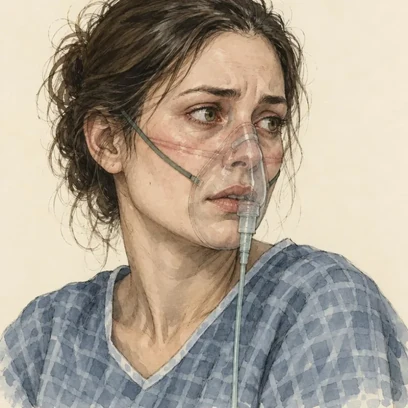
Rigid Rita
ARDS
Written lecture — video coming
The memory hook
Refractory hypoxemia, stiff lungs, white-out on x-ray
The story
Rita survives the sepsis that started it all, then her lungs turn to concrete. The x-ray goes white from edge to edge and every liter of oxygen she gets seems to disappear.
Rita works as a master concrete mason, renowned across the county for her stern work ethic and unwavering, unbending demeanor. Her nickname, Rigid Rita, perfectly embodies the horrifying pathophysiology of Acute Respiratory Distress Syndrome. In ARDS, following a catastrophic systemic insult, inflammatory cytokines trigger extensive endothelial damage within the alveolar-capillary membrane. This sudden, excessive permeability allows massive amounts of protein-rich fluid to pour directly into Rita's interstitial spaces and alveoli. As pulmonary surfactant becomes inactivated and dilutes away, widespread microatelectasis takes hold, and the elastic parenchymal tissue rapidly stiffens. Rita's spongy, compliant lungs literally turn to rigid, wet concrete, creating an insurmountable physical barrier that drastically impairs gas diffusion and prevents vital alveolar expansion.
Her downward spiral began two days after she was hospitalized for severe acute pancreatitis, a potent inflammatory trigger known to unleash systemic capillary leakage. While her abdominal pain seemed to stabilize, subtle warning signs surfaced forty-eight hours into her admission. Rita grew uncharacteristically restless, tossing in bed as her respiratory rate crept quietly from eighteen to twenty-eight breaths per minute. She voiced a persistent feeling of air hunger that would not resolve. Despite receiving escalating levels of supplemental oxygen through a nasal cannula and then a simple face mask, her pulse oximetry kept sliding downward. Rita was caught in the rapid twenty-four to forty-eight hour window where acute lung injury transforms silently from mild tachypnea into full-blown non-cardiogenic pulmonary failure.
The crisis peaked when Rita developed severe dyspnea, gasping frantically while using her sternocleidomastoid muscles to force air into her chest. Auscultation revealed diffuse, fine crackles throughout all lobes, and the manual resuscitator bag felt impossibly hard to squeeze against her stiffened airways. On a non-rebreather mask delivering one hundred percent FiO2, her SpO2 remained critically fixed at eighty-two percent, demonstrating textbook refractory hypoxemia. Arterial blood gas results revealed profound hypoxemia and evolving respiratory acidosis, with a PaO2 of 52 mmHg, PaCO2 of 56 mmHg, and a pH of 7.26. Her PaO2 to FiO2 ratio plunged to 52, far below the diagnostic threshold of 100 for severe ARDS. A chest radiograph revealed bilateral white-out infiltrates, while normal BNP excluded cardiogenic pulmonary edema.
The intensive care nurse recognized the emergency, immediately summoned the critical care provider, and prepared for emergent endotracheal intubation. The nurse set the ventilator to lung-protective ventilation, dialing tidal volumes to six milliliters per kilogram of predicted body weight while initiating positive end-expiratory pressure at fourteen centimeters of water to recruit collapsed alveoli. Continuous intravenous infusions of propofol for sedation and fentanyl for analgesia were started, followed by intravenous cisatracurium for complete neuromuscular blockade to eliminate patient-ventilator dyssynchrony. The team then turned Rita into the prone position for sixteen hours to dramatically improve oxygenation. Aggressive intravenous fluid administration was strictly contraindicated to prevent worsening alveolar flooding, while the nurse continuously monitored for hypotension and diminished unilateral breath sounds signaling barotrauma from elevated airway pressures.
The setup
Rita is recovering from severe pancreatitis when her respiratory rate creeps up.
The turn
Within 24 hours she needs a non-rebreather, and her SpO₂ still sits at 85%.
The crisis
Chest x-ray shows bilateral white-out infiltrates with no heart failure to explain it. Her lungs are stiff and hard to bag.
The save
She is intubated on low tidal volumes (6 mL/kg) with high PEEP, sedated, and turned prone for 16 hours a day.
Already a member? Sign in