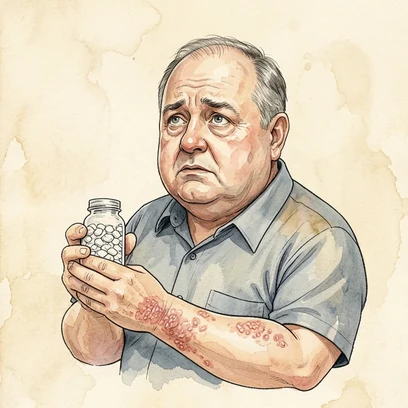
Steroid Stan
Corticosteroid Therapy: Never Stop Abruptly, Watch Sugar and Hidden Infection
Written lecture — video coming
The memory hook
He felt better, so he stopped his prednisone on Friday — by Sunday his pressure was bottoming out
The story
Stan's face is round, his arms bruise easily, and after stopping prednisone on his own he arrives weak, nauseated and hypotensive.
Stan is a retired construction foreman who earned his nickname for the sheer stubbornness with which he manages his own healthcare decisions, a trait that serves him poorly once he begins long-term prednisone therapy for severe rheumatoid arthritis. Exogenous corticosteroids like the prednisone Stan takes daily suppress his hypothalamic-pituitary-adrenal axis, signaling his own adrenal glands to essentially stop producing natural cortisol since the medication is supplying more than enough from outside. This suppression develops gradually and silently over weeks of therapy, and it means Stan's body has quietly lost its own independent capacity to respond to physical stress, an invisible vulnerability that becomes catastrophic the moment his external steroid supply disappears without warning.
After eight months of daily prednisone that finally brings his joint pain and swelling under control, Stan decides one Friday that he feels genuinely well for the first time in years and simply does not need the medication anymore. Rather than calling his rheumatologist to discuss a taper, Stan stops his prednisone abruptly that same day, confident that feeling good means his body has healed. He tells his wife proudly that he is done relying on pills, unaware that his adrenal glands, suppressed for months, cannot simply resume normal cortisol production overnight just because the external source has vanished.
By Sunday morning, less than forty-eight hours after his last dose, Stan feels profoundly weak and dizzy when he stands from bed, and his wife finds him pale and sweating at the kitchen table, complaining of severe nausea and abdominal pain. His blood pressure, taken by paramedics called to the home, reads a dangerously low 78 over 42, and his fingerstick glucose comes back at 58 milligrams per deciliter despite no history of diabetes. These findings, hypotension, hypoglycemia, and profound weakness appearing so suddenly after abrupt steroid discontinuation, represent a classic acute adrenal crisis, a life-threatening emergency caused entirely by his adrenal glands' inability to produce the cortisol his body desperately needs during this physiologic stress.
In the emergency department, the nurse anticipates and administers emergency intravenous hydrocortisone to replace the missing cortisol immediately, alongside aggressive IV fluid resuscitation to correct his profound hypotension and dextrose to address his hypoglycemia. She monitors his vital signs and glucose closely as he stabilizes over the following hours and, once he is coherent and safe, delivers the teaching he desperately needed months earlier: corticosteroid therapy lasting more than two to three weeks must always be tapered gradually under provider guidance, never stopped abruptly, because the suppressed adrenal glands need time to resume their own natural cortisol production safely. She also reminds him that steroids can mask the usual signs of infection, so any sore throat or wound changes deserve prompt reporting even without a fever.
The setup
Stan starts long-term prednisone for an inflammatory condition and quickly feels better.
The turn
Over months his face rounds out, he gains weight, his sugar rises and his skin bruises with the lightest bump.
The crisis
Feeling well, Stan stops the medication cold. Within two days he is weak, nauseated, dizzy and hypotensive.
The save
Steroids are restarted and tapered properly. Stan learns to take them in the morning with food, check his glucose, report any fever and never stop on his own.
Already a member? Sign in