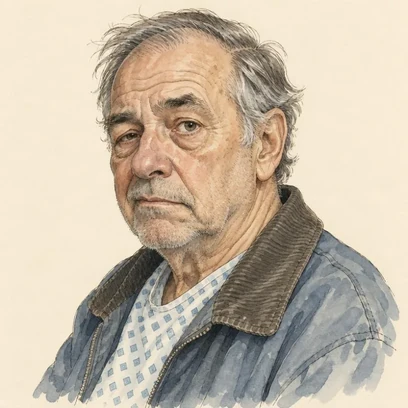
Stroke Stan
Ischemic Stroke
Written lecture — video coming
The memory hook
Time is brain — last known well decides everything
The story
Stan's left brain loses its blood supply mid-sentence. The right side of his face falls, his arm drifts down, and a clock nobody can pause starts running.
Stan was a retired horologist who spent forty meticulous years repairing antique grandfather clocks, judging life by the steady rhythm of swinging pendulums. Known around town as Stroke Stan, his very moniker became an ironic testament to the sudden vascular disruption that halted his internal machinery. Within the cerebral circulation, the intricate arterial gears depend entirely on uninterrupted perfusion to nourish billions of neurons. When an embolus travels up through the internal carotid and firmly lodges in Stan’s middle cerebral artery, downstream oxygen and glucose delivery cease abruptly. Brain tissue surrounding the vascular occlusion rapidly starved, shifting into electrical silence within minutes. Much like an escapement wheel jammed by a stray metal filing, Stan's left hemisphere lost perfusion, turning his orderly, clockwork world into an urgent race against progressive neuronal death.
The mechanical failure inside Stan had been silently winding up for years through unmanaged cardiovascular risk factors. He ignored his chronic hypertension, dismissing readings hovering around 168/96 mmHg as mere occupational stress, while refusing daily antihypertensive therapy. Even worse, an undiagnosed flutter of nonvalvular atrial fibrillation caused his left atrium to quiver erratically rather than contracting smoothly. Blood stagnated within the left atrial appendage, quietly forming fragile fibrin-rich thrombi without causing an ounce of pain. Stan occasionally noticed fleeting moments of mild dizziness, transient right-sided visual dimming, and clumsy finger dexterity when winding mainsprings, but he blamed advancing age. Without systemic anticoagulation to dissolve evolving clots or blood pressure control to protect his fragile endothelial lining, a loose thrombus finally sheared off into arterial circulation, waiting for the breakfast hour to strike.
At precisely 7:40 in the morning, Stan dropped his coffee mug as his right arm suddenly drifted limply downward. His wife gasped as the right corner of his mouth sagged into a severe facial droop, and his attempt to say good morning dissolved into incomprehensible garble. In the emergency department, his National Institutes of Health Stroke Scale score tallied a significant fourteen, reflecting dense hemiparesis and expressive aphasia. The clinical team immediately drew labs, verifying a blood glucose of 112 mg/dL to rule out hypoglycemia mimicking focal deficits, alongside an international normalized ratio of 1.0 and platelets at 225,000/mcL. An emergent non-contrast computed tomography scan of the head revealed no acute intracranial hemorrhage, confirming an acute ischemic infarction ripe for immediate intervention before irreversible penumbral necrosis claimed his motor cortex.
The nurse immediately prioritized establishing Stan’s exact last known well time at 7:40 AM, rapidly activating the institutional stroke protocol. With intracranial hemorrhage successfully ruled out on non-contrast imaging, the nurse initiated intravenous alteplase within the strict 3 to 4.5-hour therapeutic window. Strict hemodynamic control was maintained using intravenous nicardipine titrations, keeping blood pressure strictly below 180/105 mmHg to prevent fatal hemorrhagic transformation. The nurse conducted frequent neurological assessments every fifteen minutes, instituting comprehensive bleeding precautions for the next twenty-four hours. Any sudden headache or vomiting was treated as a red flag for intracranial bleeding. Crucially, the nurse maintained absolute NPO status, completely withholding all oral liquids, medications, and food until a formal bedside dysphagia swallow screen was safely passed to prevent life-threatening aspiration pneumonia.
The setup
Untreated atrial fibrillation, no anticoagulant, blood pressure never controlled.
The turn
At breakfast his face droops on one side, his arm drifts when raised, and his speech turns to mush. His wife notes the time: 7:40.
The crisis
In the ED the decision hinges on one scan: is this a clot or a bleed?
The save
Alteplase within the window, then neuro checks, tight blood pressure limits, bleeding precautions and a swallow screen before his first sip.
Already a member? Sign in