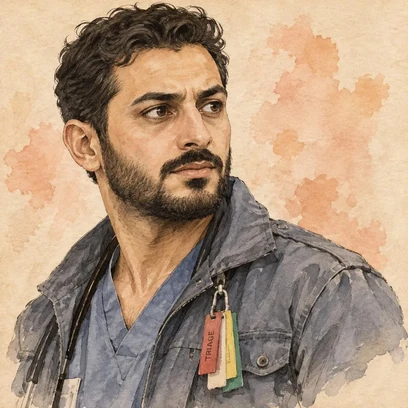
Triage Theo
Disaster Triage & Prioritization
Written lecture — video coming
The memory hook
In a mass casualty event, the sickest client doesn't always go first — resources go where they can save the most lives
The story
Twelve casualties arrive within ten minutes of a highway pileup, and Theo has one physician, two nurses and a single trauma bay. He has seconds to sort who gets seen first.
Theo built a distinguished career as an air traffic controller before transitioning into emergency nursing, and his colleagues nicknamed him Triage Theo for his uncanny, almost eerie ability to rapidly sort chaotic, competing priorities into a clear, workable sequence under intense pressure. Just as he once decided within seconds which incoming aircraft needed immediate runway clearance, Theo now applies that same rapid, high-stakes sorting instinct to sorting human casualties during overwhelming emergencies. Disaster triage fundamentally inverts everyday clinical thinking, shifting the guiding principle away from treating whichever single client appears sickest first, toward achieving the greatest possible good for the greatest possible number of victims given genuinely scarce and finite available resources.
On an unusually chaotic Friday evening, a devastating multi-vehicle pileup on the nearby interstate sends twelve critically injured casualties pouring into Theo's small rural emergency department almost simultaneously, all arriving within roughly ten minutes of each other. Theo, serving as charge nurse that overwhelmed night, finds himself with only one physician, two available nurses, and a single functional trauma bay to somehow manage this sudden surge. There is no time whatsoever for detailed, comprehensive individual assessments; instead, Theo must apply the rapid START triage algorithm, evaluating each victim's ability to walk independently, their respiratory rate, their capillary refill or palpable pulse, and their ability to follow simple verbal commands within mere seconds per person.
Moving methodically down the growing line of casualties, Theo encounters one victim exhibiting only agonal, irregular gasping respirations with absolutely no palpable pulse anywhere, and completely unresponsive, fixed pupils despite Theo's immediate attempt at repositioning the airway. Just steps away, another victim has a visibly threatened, partially obstructed airway but remains breathing independently and still responds purposefully to painful stimuli. This gut-wrenching moment represents disaster triage at its most difficult, because the physiologically sound decision runs directly counter to Theo's every instinct as a compassionate nurse trained to help the most critically injured client first, regardless of the broader resource picture around him.
Theo swiftly tags the ambulatory, minimally injured victims green, designating them safely as the walking wounded who can reasonably wait. Following strict START protocol, he tags the pulseless, apneic victim black, or expectant, only after that single failed airway repositioning attempt confirms survival is genuinely unlikely even with every available resource thrown at the case. He immediately tags the victim with the threatened but still functioning airway red, directing immediate hands-on treatment their way without any further delay. Throughout the unfolding chaos, Theo continuously directs his limited remaining staff to repeatedly reassess every yellow-tagged, delayed victim, understanding fully that any single individual's triage category can shift rapidly as both their condition and the department's available resources continue evolving.
The setup
A multi-vehicle crash overwhelms Theo's rural emergency department with a dozen casualties and minimal staff to match.
The turn
Theo quickly assesses each victim's ability to walk, respiratory rate, capillary refill and ability to follow simple commands.
The crisis
One victim has agonal, gasping respirations with no palpable pulse and unresponsive pupils despite airway repositioning, while another has a threatened airway but is still breathing and responsive to pain.
The save
Theo tags the walking wounded green, sends the unresponsive non-breathing victim to black after one airway repositioning attempt fails, tags the victim with the threatened airway red for immediate treatment, and directs staff to reassess yellow-tagged victims frequently as resources free up.
Already a member? Sign in