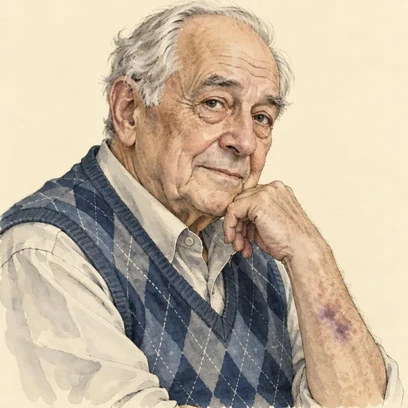
Warfarin Wally
Anticoagulation
Written lecture — video coming
The memory hook
Warfarin → INR → vitamin K; heparin → aPTT → protamine
The story
Wally thins his blood to stop the next clot — and every day after that is a balancing act between clotting and bleeding, measured in a single number.
Wallace Vance, known affectionately along the waterfront docks as Warfarin Wally, is a sixty-year-old harbormaster who prides himself on keeping shipping lanes orderly and free of navigational jams. Just like the narrow maritime channels he governs, Wally's vascular system requires smooth, unobstructed transit to prevent catastrophic blockages. His nickname mirrors his daily struggle with oral anticoagulation, a medication regimen designed to suppress vitamin K-dependent hepatic synthesis of clotting factors two, seven, nine, and ten. Wally is a methodical, stubborn man who keeps a weathered pocket logbook of every vessel docking at dawn. Yet beneath his steady maritime exterior, his vascular balance remains intensely delicate, because preventing an occlusive thrombus in his deep veins simultaneously creates an ever-present vulnerability to uncontrolled systemic hemorrhage throughout his entire vascular network.
Wally's medical voyage began two months ago when an eight-hour transatlantic flight culminated in a throbbing, swollen, erythematous right calf diagnosed as an acute deep vein thrombosis. In the hospital, providers immediately bridged him from an intravenous unfractionated heparin infusion to daily oral warfarin, requiring five days of overlapping therapy until his extrinsic clotting pathway adequately suppressed. Upon discharge, Wally was told that green leafy vegetables contain vitamin K, so he impulsively started eating massive bowls of raw kale every lunch to pursue sudden health. This surging dietary vitamin K directly antagonized his warfarin, driving his International Normalized Ratio down to a subtherapeutic 1.4. Frustrated by erratic clinic numbers, he subsequently finished a ten-day course of broad-spectrum antibiotics for bronchitis, which decimated his intestinal flora and eliminated natural vitamin K synthesis.
The clinical crisis struck three days after Wally completed the antibiotic course, while he was logging cargo manifests at the harbor terminal. Wally noticed his gums were oozing persistent pink froth every time he spit, followed by spontaneous bilateral epistaxis that soaked three dockside shop rags. When he used the restroom, he passed dark, sticky, foul-smelling melena, and his urine appeared distinctly smoky red. In the emergency department, his blood pressure registered 96/58 millimeters of mercury with a compensatory heart rate of 118 beats per minute. STAT coagulation studies revealed an alarmingly supratherapeutic International Normalized Ratio of 6.8, well above his target therapeutic range of 2.0 to 3.0. Wally's hemoglobin dropped sharply from 14.2 to 9.8 grams per deciliter, confirming significant internal gastrointestinal blood loss.
The emergency nurse executed priority anticoagulation interventions immediately, placing Wally on strict bed rest and establishing large-bore intravenous access before withholding his scheduled warfarin dose. Following provider orders, the nurse administered phytonadione, also known as vitamin K, via slow intravenous infusion to prompt hepatic factor regeneration, while holding packed red blood cells on standby. The nurse placed Wally on full bleeding precautions, banning venipunctures unless vital, initiating manual blood pressure cuffs, and enforcing a soft-bristle swab for oral care. Nonsteroidal anti-inflammatory drugs and intramuscular injections were strictly contraindicated due to disastrous hematoma and hemorrhage risks. For heparin patients, the nurse recalled that intravenous protamine sulfate remains the mandatory antidote, while Wally's situation specifically demanded vitamin K reversal alongside continuous reassessment of his neurologic baseline to rule out fatal intracranial hemorrhage.
The setup
After a DVT, Wally is bridged from a heparin infusion to warfarin.
The turn
He decides kale is healthy and eats a large salad every day, and his INR drifts to 1.4.
The crisis
After an antibiotic course his INR jumps to 6.8 and he has black tarry stools and gum bleeding.
The save
Warfarin is held, vitamin K given, and Wally learns soft toothbrush, electric razor, no NSAIDs, and to report black stools or unusual bruising.
Already a member? Sign in