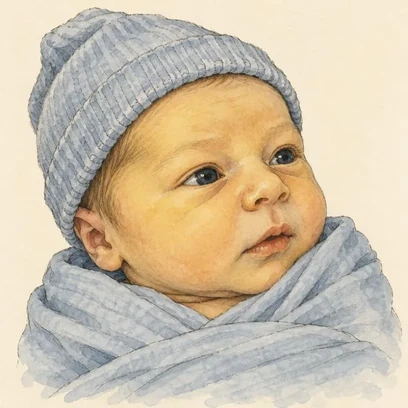
Yellow Yusuf
Newborn Hyperbilirubinemia & Phototherapy
Written lecture — video coming
The memory hook
Jaundice head-to-toe by day 2-3 — eyes covered, skin bare under lights
The story
Yusuf is born healthy but by day two his skin has taken on a golden tint that starts at his face and creeps toward his toes. His mother worries he looks more yellow every time she checks.
Newborn Yusuf entered the world at thirty-eight weeks, a calm, dusky-haired infant whose peaceful presence charmed the entire postpartum unit. Yet his moniker, Yellow Yusuf, became an urgent clinical reality as his immature metabolic systems faced their first major physiological trial. In utero, maternal circulation handled waste, but independently, Yusuf had to clear a massive influx of breaking-down fetal erythrocytes on his own. This breakdown released copious amounts of unconjugated, lipid-soluble bilirubin into his bloodstream. Yusuf’s tender, developing liver lacked the full complement of glucuronyl transferase enzymes required to rapidly conjugate this compound into a water-soluble form for gastrointestinal clearance. Consequently, the vibrant yellow pigment escaped hepatic processing and circulated freely, ready to deposit into his vulnerable peripheral tissues.
Yusuf’s early hours seemed uneventful, but his breastfeeding pattern established slowly, delivering modest colostrum intake that delayed gastrointestinal motility. Without frequent bowel movements to excrete conjugated bilirubin, enterohepatic circulation reabsorbed the pigment back into his vascular space. Crucially, Yusuf remained entirely pink during his first twenty-four hours of life, ruling out immediate erythrocyte destruction from hemolytic incompatibility. By hour thirty-six, however, classic physiologic jaundice made its undeniable entrance. The pigment first tinted his sclera and blanchable forehead skin, then steadily migrated downward across his nose, chest, and upper abdomen in a textbook cephalocaudal progression. His mother noticed the creeping golden hue during diaper changes, unaware that this head-to-toe advancement mirrored the inexorable rise of unconjugated bilirubin saturating his peripheral tissues.
By day three, approximately fifty-four hours postpartum, Yusuf’s golden tint reached his lower extremities and palms. More alarming than the deep color was his sudden behavioral shift: Yusuf became increasingly lethargic, difficult to arouse for scheduled feedings, and uttered an irritable, high-pitched cry when disturbed. His noninvasive transcutaneous bilirubin screening flashed an alarming 16.8 mg/dL, prompting immediate venipuncture. Laboratory analysis confirmed severe hyperbilirubinemia, reporting a total serum bilirubin of 18.2 mg/dL, predominantly unconjugated, which plotted dangerously high on the hour-specific Bhutani nomogram. His direct Coombs test returned negative, confirming an exaggerated physiologic process rather than isoimmunization. The clinical team recognized that without swift intervention, this unbound, neurotoxic bilirubin would breach Yusuf's blood-brain barrier, triggering acute bilirubin encephalopathy and irreversible kernicterus.
The nurse initiated immediate rescue measures to halt Yusuf’s neurological decline. First, the nurse placed opaque eye shields securely over his eyes to prevent retinal phototoxicity, ensuring his nares remained patent. Next, Yusuf was undressed down to a minimal diaper and positioned beneath intensive blue phototherapy lights, maximizing bare skin exposure to allow photoisomerization to convert bilirubin into water-soluble lumirubin. The nurse coordinated feeds every two hours, providing fortified breast milk to stimulate bowel evacuation, warning the parents that frequent, loose, greenish stools indicated therapeutic excretion. The nurse closely monitored Yusuf's axillary temperature and hydration status, while trending repeat bilirubin levels every four to six hours. Crucially, the nurse ensured no topical lotions or oils were applied, as they cause severe cutaneous burns under phototherapy.
The setup
Yusuf is born at 38 weeks, breastfeeding well but slowly establishing a feeding pattern in his first day of life.
The turn
On day two, his face and chest take on a yellow tint that was not there at birth.
The crisis
By day three his total bilirubin is climbing rapidly and now his arms and legs are yellow too, and he is feeding poorly and difficult to arouse.
The save
Yusuf is placed under phototherapy with his eyes shielded and only a diaper on, he is fed frequently to promote bilirubin excretion in stool, and his bilirubin is trended every few hours.
Already a member? Sign in