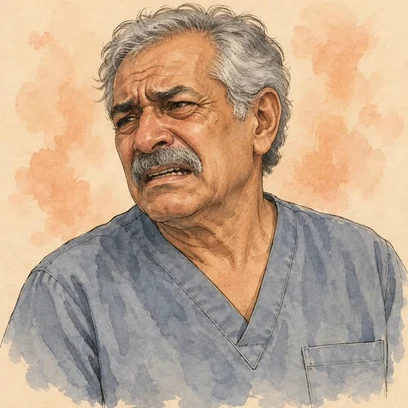
Aneurysm Arturo
Abdominal Aortic Aneurysm
Written lecture — video coming
The memory hook
Pulsatile abdominal mass, sudden tearing back pain, and a dropping BP — never palpate deeply once rupture is suspected
The story
Arturo, a 68-year-old smoker with longstanding hypertension, comes to the ED with sudden, severe back and abdominal pain, and the triage nurse feels a pulsatile mass just left of his umbilicus.
Arturo is a retired dockworker known throughout his neighborhood as Aneurysm Arturo, a nickname born from his decades spent hauling and inspecting heavy shipping cables that occasionally weakened and bulged under repeated strain. That mechanical metaphor now describes his own aorta with chilling accuracy. Years of chronic hypertension and a persistent two-pack-a-day smoking habit have systematically degraded the elastin and collagen fibers within his abdominal aortic wall. Just like an overstressed cable slowly ballooning at its weakest point before snapping, Arturo's infrarenal aorta has been silently dilating for years, an invisible ticking clock hidden deep within his abdomen, waiting for the moment his weakened vessel wall can no longer withstand arterial pressure.
During a routine wellness visit unrelated to his vascular health, an abdominal ultrasound incidentally revealed a four-point-eight centimeter infrarenal aortic aneurysm. Because this measurement fell below the widely accepted surgical threshold of five-point-five centimeters, his vascular surgeon recommended conservative surveillance imaging every six months alongside aggressive risk factor modification. Arturo was counseled extensively on smoking cessation and strict blood pressure control, understanding that both factors accelerate aneurysmal expansion. For nearly a year, Arturo dutifully attended his follow-up appointments, but he never fully quit smoking, and his blood pressure remained stubbornly elevated in the 160s systolic despite his prescribed antihypertensive regimen, leaving his aneurysm vulnerable to continued silent growth.
The catastrophe struck without warning on an ordinary Tuesday afternoon while Arturo was gardening. He suddenly doubled over with tearing, ripping pain radiating through his abdomen and directly into his lower back, a sensation he later described as being stabbed from the inside. His wife called emergency services immediately, and paramedics found him pale, diaphoretic, and hypotensive with a blood pressure of eighty-two over fifty-four. On arrival, the triage nurse cautiously palpated a pulsatile, tender periumbilical mass, confirming everyone's worst suspicion. Bedside ultrasound revealed free intraperitoneal fluid consistent with active rupture, and Arturo's hemoglobin had already dropped from a baseline of fourteen to nine grams per deciliter, signaling significant ongoing hemorrhage into his abdominal cavity.
The trauma nurse immediately avoided any further deep abdominal palpation, recognizing that additional manipulation could dramatically worsen the rupture. Two large-bore intravenous lines were placed, but the team deliberately employed permissive hypotension, administering only enough crystalloid fluid to maintain a systolic pressure around ninety rather than fully normalizing it, since aggressive fluid resuscitation would raise arterial pressure against the already-leaking aortic wall and accelerate blood loss. Arturo was kept strictly NPO, type and crossmatch for emergency blood products was sent immediately, and the vascular surgical team was activated for emergent open or endovascular repair. Within minutes, Arturo was wheeled directly into the operating room for definitive surgical control of the hemorrhage.
The setup
Arturo has smoked for 40 years and has poorly controlled hypertension, both major risk factors for aneurysmal degeneration of the aorta.
The turn
An incidental ultrasound during a routine visit shows a 4.8 cm infrarenal aortic aneurysm, and Arturo is scheduled for surveillance imaging every six months.
The crisis
Arturo suddenly develops tearing back and abdominal pain, his blood pressure drops to 82/54, and a pulsatile, tender abdominal mass is now palpable.
The save
The nurse avoids deep palpation of the abdomen, keeps Arturo NPO, obtains large-bore IV access with permissive hypotension fluid strategy, and the surgical team rushes him to emergent repair.
Already a member? Sign in