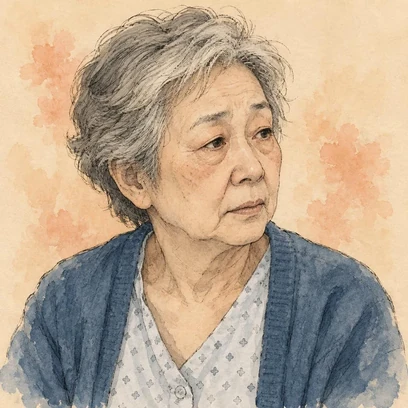
Claudicating Clara
Peripheral Arterial Disease vs Venous Insufficiency
Written lecture — video coming
The memory hook
Cold, pale legs that hurt with walking and improve with dangling — arterial disease is the opposite of venous
The story
Clara complains that her right calf cramps every time she walks two blocks and eases when she stops, while her left leg is swollen, brownish at the ankle, and aches worse the longer she stands.
Clara worked for thirty years as a department store shoe fitter, spending countless hours kneeling and standing on hard tile floors while helping customers find the perfect fit. Her coworkers nicknamed her Claudicating Clara decades ago, a joke about how she would pause mid-aisle to rub her aching legs, never realizing the nickname would one day describe two genuinely distinct vascular diseases battling within her own limbs. Her right leg embodies peripheral arterial disease, where atherosclerotic plaques starve her calf muscles of oxygen during exertion, producing cramping claudication. Her left leg instead embodies chronic venous insufficiency, where incompetent valves allow blood to pool and stagnate. The name captures both conditions perfectly, since claudication defines the arterial limb while sluggish pooling defines the venous one.
Decades of smoking two packs daily combined with poorly controlled type two diabetes steadily narrowed the arteries supplying Clara's right leg, while long-neglected varicose veins in her left leg slowly stretched and destroyed the delicate one-way valves within her saphenous system. She began noticing that walking roughly two city blocks reliably triggered a deep, cramping pain in her right calf that vanished completely within minutes of resting, a pattern she initially dismissed as ordinary muscle fatigue from standing all day. Meanwhile, her left ankle grew progressively more swollen by evening, developing an uncomfortable, heavy aching sensation that worsened dramatically the longer she remained standing on the sales floor.
Eventually, Clara's right great toe developed a small, painful, well-demarcated ulcer with a pale, punched-out wound bed that refused to bleed even with gentle debridement, and her pedal pulses on that side were barely palpable using Doppler. Simultaneously, her left medial malleolus developed a shallow, irregularly shaped, weeping ulcer surrounded by thick, brownish hemosiderin-stained skin and pitting edema. An ankle-brachial index confirmed severe arterial insufficiency on the right at zero-point-six, while venous duplex ultrasound confirmed significant reflux and valvular incompetence on the left. Clara now faced the confusing reality of needing completely opposite treatment approaches for each leg simultaneously.
The wound care nurse carefully explained that Clara's right, arterial leg needed to remain in a dependent position, allowing gravity to assist blood flow into the ischemic tissue, while compression stockings and elevation were strictly forbidden on that limb because they would further choke off already inadequate circulation. Conversely, her left, venous leg required the opposite approach entirely, with elevation above heart level whenever resting and properly fitted graduated compression stockings applied daily to reduce chronic venous stasis and edema. The nurse also emphasized urgent smoking cessation, structured supervised walking therapy to build collateral arterial circulation, and meticulous daily foot inspection to prevent infection in both vulnerable limbs.
The setup
Clara has a 30-year smoking history, diabetes, and varicose veins that have gone untreated for over a decade.
The turn
Her right foot becomes cool and pale when elevated, with diminished pedal pulses, while her left ankle shows brawny, brownish skin discoloration and pitting edema.
The crisis
A small wound develops on her right great toe with a pale, punched-out wound bed and no bleeding, while her left medial ankle has a shallow, irregular, weeping ulcer.
The save
The nurse positions Clara's arterial leg in a dependent position to promote blood flow and keeps the venous leg elevated with compression therapy, teaching Clara the opposite positioning rules for each condition.
Already a member? Sign in