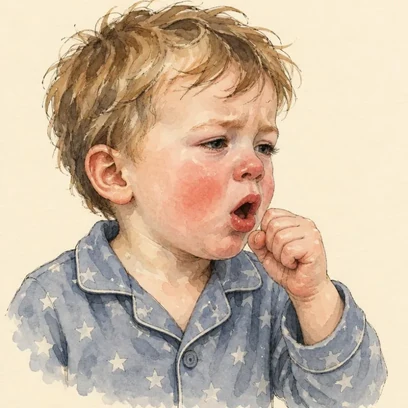
Barking Benny
Croup (Laryngotracheobronchitis)
Written lecture — video coming
The memory hook
Seal-bark cough, inspiratory stridor at rest — cool mist, keep him calm
The story
Benny wakes at 2 a.m. with a cough that sounds like a seal barking, gasping for each breath in between. His mother says he had a runny nose and low fever for two days before this.
Eighteen-month-old Benny is a spirited toddler known for mimicking zoo animals, but tonight his playful impressions have turned into a terrifying clinical reality. His family affectionately calls him Barking Benny because of the harsh, brassy cough currently echoing from his tiny throat. Benny's condition stems from acute laryngotracheobronchitis, a viral invasion most frequently caused by parainfluenza that targets the pediatric upper airway. In small children between six months and three years, the airway diameter is naturally narrow, making any inflammation disproportionately dangerous. Benny’s subglottic area, the narrowest segment of an infant's larynx beneath the vocal cords, is severely swollen with inflammatory edema. As turbulent air forces its way past this narrowed, rigid funnel, his voice drops into a hoarse rasp, transforming ordinary breathing into a strained, bark-like mechanical struggle.
Benny's illness began innocuously three days ago with mild clear rhinorrhea, intermittent sneezing, and a low-grade fever lingering at 100.4 degrees Fahrenheit. His mother assumed he had caught a common seasonal cold from daycare, giving him fluids and letting him rest comfortably in his crib. However, viral pathogens in young airways systematically advance from the nasopharynx down toward the larynx and trachea over forty-eight to seventy-two hours. By bedtime, Benny's slight sniffles transformed into a raspy, hoarse voice when he asked for his bedtime water. As the dry nighttime air cooled Benny’s bedroom, the mucosal swelling beneath his vocal cords tightened significantly. At two o’clock in the morning, Benny woke abruptly, gasping for breath and producing the unmistakable sound of a frightened seal echoing across the dark hallway.
In the emergency department, Benny presents with classic moderate-to-severe croup. He sits bolt upright in acute distress, exhibiting audible high-pitched inspiratory stridor even at rest. Suprasternal and intercostal retractions visibly pull his chest inward with each labored breath, and his pulse oximetry reveals an oxygen saturation dropping to 91 percent on room air. His respiratory rate spikes to 48 breaths per minute, accompanied by marked restlessness signaling early hypoxemia. The clinical evaluation yields an elevated Westley croup score, confirming significant airway narrowing without needing invasive tests. An anterior-posterior neck radiograph reveals classic subglottic tracheal narrowing known as the steeple sign, where the normally rounded airway tapers into an inverted V. Benny remains exhausted, struggling to pull air through his compromised, swollen subglottic funnel.
The nurse initiates immediate, decisive pediatric interventions, prioritizing an atmosphere of calm. Agitation increases respiratory distress and worsens subglottic swelling, so the nurse leaves Benny sitting comfortably on his mother’s lap while administering cool humidified oxygen blow-by. The nurse avoids tongue blades or intrusive oral examinations, which could provoke complete laryngospasm or fatal obstruction. To reverse airway inflammation, the nurse administers oral dexamethasone at 0.6 milligrams per kilogram, providing long-lasting steroid coverage. Concurrently, nebulized racemic epinephrine is delivered to induce rapid subglottic vasoconstriction, swiftly reducing mucosal edema and easing his inspiratory stridor within fifteen minutes. Knowing racemic epinephrine provides only temporary relief with a half-life under two hours, the nurse monitors Benny closely for at least three to four hours to catch dangerous rebound stridor.
The setup
A few days of rhinorrhea and low-grade fever look like an ordinary cold in this 18-month-old.
The turn
By night his voice turns hoarse and each cough sounds like a barking seal, worse when he cries and worse in the dry night air.
The crisis
In the emergency department Benny is stridorous even at rest, sitting up and tugging to breathe, with visible suprasternal retractions.
The save
The nurse keeps him calm in his mother's lap, gives cool humidified oxygen, administers nebulized racemic epinephrine and oral dexamethasone, and watches for stridor to return after the epinephrine wears off.
Already a member? Sign in