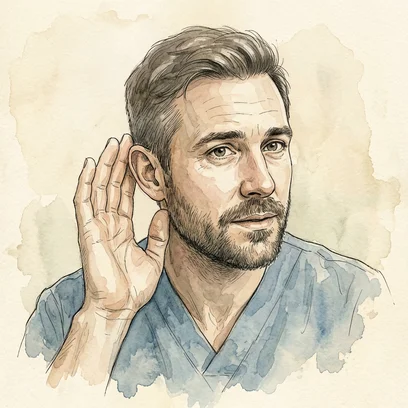
Listening Theo
Therapeutic Communication: What to Say, and What Never to Say
Written lecture — video coming
The memory hook
The right answer is almost never advice, reassurance or a question starting with 'why'
The story
Theo pulls a chair to eye level, puts his hands in his lap, and says almost nothing. The client finally starts talking.
Theo worked as a psychiatric mental health nurse whose colleagues nicknamed him for his almost uncanny ability to sit quietly with a distressed client without rushing to fill every silence with words, something many newer staff found deeply uncomfortable to practice themselves. Theo understood that therapeutic communication is a genuine clinical skill, not mere politeness, because anxiety, grief, and psychosis all narrow a person's ability to process information and express themselves clearly. Techniques that open space, such as silence, reflection, open-ended invitations, and simple observations, gather far more accurate and honest data than questions demanding justification, while advice, false reassurance, and any question beginning with the word why tend to shut the exchange down entirely and shift the focus uncomfortably back onto the nurse rather than the client's actual experience.
Theo is assigned to a client who was recently admitted after the sudden, unexpected death of a spouse, and the client sits curled in a chair by the window, staring blankly outside and answering only in short, flat phrases whenever anyone speaks to her. A well-meaning nursing assistant, trying to be supportive, tells the client cheerfully that everything happens for a reason and that she should try to stay positive, then quickly moves on to the next task in the room. The client's expression tightens noticeably at these words, and she turns further away toward the window, her hands gripping the armrests. Theo, observing this interaction from the doorway, recognizes immediately that this well-intentioned reassurance has actually deepened the client's sense of isolation rather than offering any genuine comfort.
Later that same shift, the client's withdrawal deepens further. She refuses her lunch tray entirely, has not spoken more than a few words in over three hours, and when Theo checks in, she suddenly states in a flat, quiet voice that she doesn't see the point of going on without her husband. This statement, delivered without visible emotion, represents an unambiguous cue that Theo cannot let pass unexplored regardless of how calmly it was spoken. Her vital signs remain stable, but her affect has flattened considerably compared to admission, and she has made no eye contact throughout their entire brief exchange, reinforcing how urgently a direct, careful assessment of her safety must happen before anything else in her care plan proceeds.
Theo responds by sitting down at her eye level, within a comfortable distance and without any physical barrier between them, and simply remains present with her for several seconds of unhurried silence before speaking. He gently reflects what he has observed, saying that she seems to be carrying an enormous weight right now, and invites her with an open-ended prompt to tell him more about what she is experiencing. When she repeats her earlier statement, Theo asks directly and without hesitation whether she has thoughts of ending her life, understanding that a direct question about suicidal intent is always appropriate and never something to dance around. He then follows through precisely on every safety measure he promises her, escalating to the full care team immediately rather than deflecting or minimizing what she has shared.
The setup
A client says quietly, 'I don't think this treatment is working.'
The turn
A well-meaning visitor answers for the nurse: 'Don't worry, everything will be fine.'
The crisis
The client says, 'Promise me you won't tell anyone what I'm about to say.'
The save
Theo sits at eye level, uses silence, reflects what he hears, and stays with the client's feelings rather than his own solutions.
Already a member? Sign in