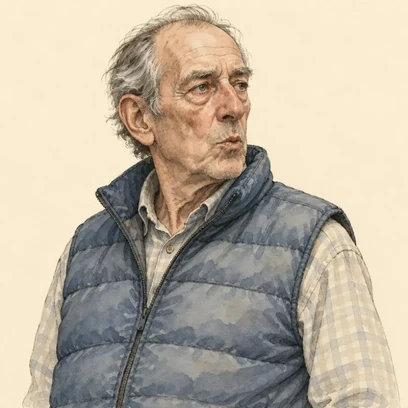
Barrel Bart
COPD
Written lecture — video coming
The memory hook
Barrel chest, pursed-lip breathing, low-flow O₂ — his drive to breathe is low oxygen
The story
Bart has smoked two packs a day for forty years and now can't finish a sentence without stopping to breathe. His chest looks rounded like a barrel, and he purses his lips every time he exhales.
Bart worked for forty years as a master cooper in an old Appalachian whiskey distillery, hammering iron hoops onto wooden casks all day long. His proudest joke was that after four decades of shaping barrels, his own torso had taken on the exact same shape. The nickname Barrel Bart stuck with him, perfectly describing the dramatic anterior-posterior widening of his ribcage. Inside his chest, countless ruined alveoli had permanently lost their elastic recoil, trapping stale air with every breath and forcing his ribcage into permanent hyperinflation. Bart was stubborn, slow-moving, and perpetually cheerful despite his wheezing, but he could no longer speak a full sentence without pausing to catch his breath. His rounded frame visually mirrored the devastating chronic obstructive pulmonary disease quietly consuming his respiratory reserve.
The true culprit behind Bart's gradual decline was not the oak sawdust from the cooperage, but the two packs of unfiltered cigarettes he smoked every day for forty years. The chronic chemical irritation destroyed his bronchial cilia, sparking a persistent low-grade inflammation that thickened his airway walls and triggered relentless mucus overproduction. At first, Bart simply brushed off his chronic morning cough and yellowish phlegm as a harmless smoker's hack. Over time, progressive alveolar destruction eliminated the surface area required for effective gas exchange, leaving him air-hungry after climbing a single flight of stairs. Stale carbon dioxide remained trapped behind collapsed bronchioles upon expiration, compelling him to instinctively purse his lips against the resistance to prolong expiratory airflow and prevent terminal alveolar collapse.
The crisis unfolded when a severe seasonal cold pushed Bart into severe dyspnea, prompting a panicking family member to place him on an unregulated high-flow non-rebreather mask at fifteen liters per minute. Within thirty minutes, Bart slumped forward in an exaggerated tripod position, barely arousable, lethargic, and cyanotic around his nailbeds. His arterial blood gas revealed severe carbon dioxide narcosis: a PaCO2 dangerously elevated at 74 mmHg, a PaO2 of 95 mmHg, and a partially compensated pH of 7.31 with an elevated bicarbonate of 36 mEq/L. His hematocrit was 58 percent, reflecting secondary polycythemia from years of chronic hypoxia, while his bedside spirometry demonstrated a severely reduced FEV1 below forty percent. Flooding his system with oxygen had abruptly obliterated his hypoxic respiratory drive.
The triage nurse recognized carbon dioxide retention immediately and acted rapidly without hesitation. First, she yanked off the high-flow mask and switched Bart to a low-flow nasal cannula at two liters per minute, strictly titrating flow to maintain a safe target oxygen saturation between 88 and 92 percent. She uprighted him into high Fowler's position to maximize diaphragmatic excursion and continuously monitored his level of consciousness and respiratory effort. Next, she administered nebulized albuterol and ipratropium via inhalation, followed by intravenous methylprednisolone to blunt bronchial inflammation. Unchecked, high-concentration oxygen therapy was strictly contraindicated, as it paralyzed his remaining hypoxic stimulus to breathe. Within the hour, as excess carbon dioxide began washing out, Bart opened his eyes and resumed spontaneous pursed-lip breathing.
The setup
Forty years of smoking destroy Bart's alveoli, trapping air and hyperinflating his lungs.
The turn
His chest has become rounded and barrel-shaped, and he instinctively purses his lips on every exhale to keep air from getting trapped.
The crisis
A well-meaning family member puts Bart on high-flow oxygen for his breathlessness, and within the hour he becomes drowsy and difficult to arouse.
The save
The nurse switches Bart to low-flow oxygen at 1–2 L/min titrated to an SpO2 of 88–92%, reinforces pursed-lip and diaphragmatic breathing, and monitors his level of consciousness closely.
Already a member? Sign in