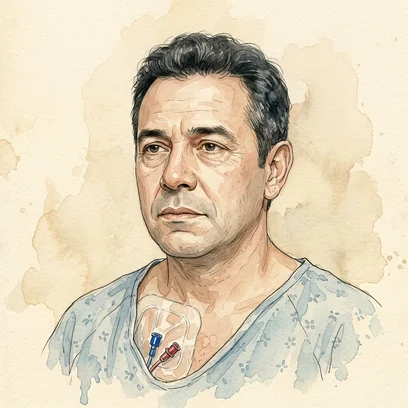
Central Line Cesar
Central Lines & Air Embolism: Clamp It, Position It, Protect It
Written lecture — video coming
The memory hook
His tubing came apart for only a few seconds — and suddenly he is gasping, dizzy and dropping his pressure
The story
Cesar's IV tubing disconnects during a dressing change. Within seconds he is short of breath, pale and frightened.
Cesar is a proud former merchant marine who spent decades securing cargo lines and hatches against the sea, earning his nickname among the hospital staff for treating every tubing connection on his own central venous catheter with the same white-knuckle vigilance he once brought to ship rigging. Cesar receives a central line for long-term chemotherapy after a colon cancer diagnosis, with the catheter tip resting in his superior vena cava, a location where intrathoracic pressure drops below atmospheric pressure during inspiration. This anatomic quirk means that if the closed system is ever breached, air does not simply sit still; it is actively pulled into the vein and can travel toward the right heart, where it forms an airlock capable of blocking pulmonary blood flow entirely, a catastrophic event known as air embolism.
Weeks into his chemotherapy cycle, Cesar is alone in his hospital room adjusting his blanket when his catheter's extension tubing, weakened from repeated connections, pops loose from its cap for just a few seconds before Cesar notices and reconnects it himself. He feels nothing unusual in that brief moment and does not mention it when the nurse arrives for his scheduled assessment, assuming it was inconsequential. He resumes reading his newspaper, unaware that even a momentary open connection at his line's level, given the negative intrathoracic pressure working against him, was enough time for air to be drawn into his central venous system.
Roughly ten minutes later, Cesar suddenly gasps and calls out for help, gripping his chest and reporting an odd sense of dizziness sweeping over him. His nurse rushes in to find his oxygen saturation dropping to 88 percent, his blood pressure sagging to 82 over 50, and his heart rate climbing to 118 beats per minute. Auscultating his chest, she hears an unusual churning, mill-wheel murmur over his precordium, a classic and ominous sign of air trapped within the right heart chambers. Cesar himself, frightened and short of breath, mentions almost as an afterthought that his tubing had come loose earlier, instantly confirming for the nurse exactly what has happened and how urgently she must act.
The nurse immediately clamps the catheter to prevent any further air entry and occludes the insertion site with her gloved hand. She positions Cesar on his left side in Trendelenburg position, head down and left-side-lying, which traps the air within the apex of the right ventricle away from the pulmonary outflow tract and prevents it from ejecting into the lungs. She applies 100 percent oxygen via non-rebreather mask to support his compromised oxygenation and calls for the rapid response team while a colleague notifies the physician. She stays at Cesar's side continuously monitoring his vital signs and level of consciousness until the emergency team arrives, never once leaving the clamped line unattended.
The setup
Cesar needs long-term antibiotics, so a central line is placed in his chest.
The turn
During a dressing change his tubing separates while he takes a deep breath in.
The crisis
Cesar gasps, grabs his chest and says the room is spinning. His pressure drops and his heart races.
The save
The nurse clamps the catheter, turns him onto his LEFT side with the head down, applies oxygen and calls for help.
Already a member? Sign in