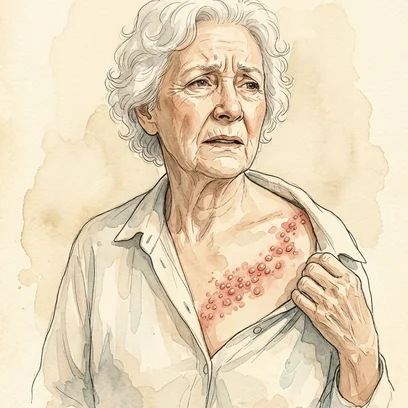
Shingles Sheila
Herpes Zoster: The One-Sided Band of Blisters and Airborne Rules
Written lecture — video coming
The memory hook
A stripe of blisters wraps one side of her chest like a belt that stops at the midline — and the pain arrived days before the rash
The story
Sheila's left chest burned for three days before a stripe of blisters appeared, wrapping from her spine to her breastbone and stopping dead at the midline.
Sheila built a decades-long career as a professional seamstress specializing in custom belts and sashes, earning the affectionate nickname Shingles Sheila from her workshop friends long before she ever developed the illness that would eventually make the name eerily fitting. Varicella-zoster virus, the same pathogen that gave her chickenpox as a child, never actually left her body afterward; instead it retreated into dormancy within her dorsal root ganglia, lying silently in wait for decades. When Sheila's immune system weakens with advancing age and the stress of a recent cancer diagnosis, the dormant virus reactivates and travels along a single sensory nerve root, producing a rash that erupts in a stripe following exactly one dermatome, a painful band that, fittingly for the seamstress who spent her life measuring belts, stops sharply and completely at the midline of her body.
Sheila first notices a burning, stabbing pain along the right side of her chest three days before any visible rash appears, a sensation she initially dismisses as muscle strain from lifting fabric bolts in her workshop. When a cluster of small, fluid-filled vesicles finally erupts across that same painful area, arranged unmistakably in a horizontal band that wraps partway around her ribcage and abruptly halts exactly at her sternum, she recognizes something is seriously wrong and seeks urgent care. Her physician immediately identifies herpes zoster, or shingles, and explains that her weakened immunity from ongoing chemotherapy has allowed the long-dormant virus to reactivate. Given how recently her rash appeared, timing now becomes critical to limiting both the severity of her outbreak and her risk of lasting nerve pain afterward.
By the time Sheila reaches the clinic, her rash has been present for just under 48 hours, well within the crucial 72-hour treatment window, though her pain has intensified to an 8 out of 10 on the numeric scale, described as constant burning interrupted by sharp, electric-shock-like jabs. Several vesicles have already begun weeping clear fluid, and a few older lesions show early crusting at their centers. Her oncologist is notified promptly given her immunocompromised status, since a disseminated or widespread outbreak in a client with weakened immunity carries far greater risk and requires more stringent precautions than a typical localized case in an otherwise healthy older adult. The clinic nurse also asks carefully whether Sheila has had any recent contact with pregnant women, newborns, or other immunocompromised individuals in her sewing circle who could be endangered by her contagious open lesions.
Sheila's nurse ensures antiviral therapy with valacyclovir is started immediately, emphasizing that beginning treatment within that critical 72-hour window meaningfully shortens the duration of her outbreak and reduces her risk of developing postherpetic neuralgia afterward. Because Sheila's lesions remain localized to one dermatome and can be fully covered with a dressing, standard contact precautions are implemented rather than the airborne precautions that would be required for disseminated zoster in an immunocompromised host. Gabapentin is added for her breakthrough nerve pain, and the nurse teaches Sheila to keep the lesions clean, covered and completely unscratched to avoid secondary bacterial infection and scarring. She reinforces that Sheila remains contagious to susceptible individuals until every single lesion has fully crusted over, and that pain may persist for months even after her skin has completely healed.
The setup
For three days Sheila's left chest burned and stung with no rash. Today a band of grouped blisters appeared on one side only.
The turn
The blisters follow the path of a single nerve like a belt across one side. Sheila cannot bear clothing touching them.
The crisis
A lesion appears near the tip of Sheila's nose and her eye is watering. On the next unit, a client on chemotherapy has blisters on both sides of the body.
The save
Sheila starts acyclovir within the 72-hour window, keeps lesions covered, and learns the fluid can give chickenpox to the unvaccinated until every blister crusts over.
Already a member? Sign in