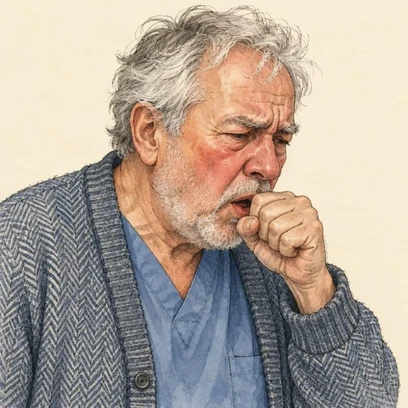
Consolidated Carl
Pneumonia
Written lecture — video coming
The memory hook
Crackles, rusty sputum, confusion in the elderly
The story
Carl aspirates a mouthful of dinner and by morning the right lower lobe of his lung is packed solid. His family says nothing is wrong except that grandpa is suddenly confused.
Carl Baxter was an eighty-four-year-old retired stone mason whose dry humor once kept construction sites lively. His grandchildren called him Consolidated Carl because his lungs became as dense and packed as setting mortar whenever respiratory infections took hold. In healthy lungs, delicate alveoli remain airy, sponge-like chambers designed for effortless gas exchange. In Carl's respiratory tract, an acute inflammatory cascade triggered by bacterial invasion flooded the alveolar sacs of his right lower lobe with purulent exudate, cellular debris, and red blood cells. The normally buoyant pulmonary parenchyma transformed into a solid, airless mass, cementing Carl's clinical moniker. What began as micro-aspiration silently converted microscopic pockets of oxygen into a dense, boggy swamp, robbing his lung tissues of their natural compliance and leaving his lower lobe entirely consolidated.
Carl's downhill slide started after a mild ischemic stroke left him with subtle pharyngeal weakness and delayed swallowing reflexes. Living independently, he developed a bad habit of eating his evening meals while slouching back in his favorite recliner, coughing softly between bites of beef stew. That chronic dysphagia and reclined posture created the perfect avenue for silent aspiration, sending colonized oral secretions past his blunted epiglottis straight down the steep path of his right mainstem bronchus. Over the next forty-eight hours, bacteria multiplied within the warm, moist bronchioles. Early warning signs were deceptively quiet. Carl skipped his morning walks, picked half-heartedly at his meals, and felt unusually sluggish, dismissing his slight throat clearing as dust irritation while purulent secretions steadily accumulated in his vulnerable right base.
By the third morning, Carl's family discovered him wandering into the hallway wearing two mismatched shirts, utterly bewildered about the day. Because older adults often lack a robust febrile response, Carl's temperature registered at a deceptively modest thirty-seven point four degrees Celsius, masking a life-threatening crisis. His respiratory rate spiked to thirty-two breaths per minute, and his pulse oximetry plummeted to eighty-eight percent on room air. Auscultation revealed inspiratory crackles and bronchial breath sounds over the right lower lobe, accompanied by dullness to percussion and increased tactile fremitus. Carl weakly coughed up thick, rust-colored sputum between groans of pleuritic chest pain. Blood tests revealed a white blood cell count of fifteen thousand per microliter with a significant left shift, while his chest radiograph confirmed dense right-lower-lobe consolidation.
The nurse moved rapidly through a prioritized clinical sequence, knowing hesitation invited septic shock. First, the nurse elevated the bed into high-Fowler's position and applied supplemental oxygen via nasal cannula at three liters per minute to restore his saturation above ninety-two percent. Before administering any medications, the nurse immediately collected two sets of blood cultures and induced an adequate sputum specimen for gram staining. Only after obtaining these cultures did the nurse hang broad-spectrum intravenous ceftriaxone, ensuring prompt antimicrobial delivery within the golden hour. The nurse initiated aggressive pulmonary hygiene, coaching Carl on incentive spirometry and sustained deep breathing while delivering intravenous normal saline to thin his tenacious secretions. Administering sedatives or heavy cough suppressants was strictly contraindicated, as Carl urgently needed to clear his infected airways.
The setup
A stroke left Carl with a weak swallow. He eats reclined and coughs at every meal.
The turn
Two days later he is febrile with a productive cough and crackles that do not clear when he coughs.
The crisis
At 84 years old his temperature is only 37.4°C — but he is confused, tachypneic and his SpO₂ is 88%.
The save
Sputum and blood cultures, then antibiotics; incentive spirometry, hydration, and head of bed up for every meal.
Already a member? Sign in