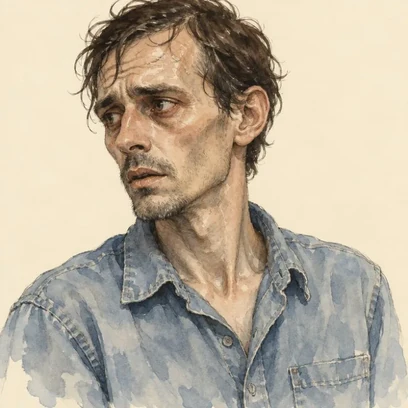
Coughing Kip
Tuberculosis
Written lecture — video coming
The memory hook
Night sweats, weight loss, airborne isolation, RIPE
The story
Kip's cough outlasts three roommates and two seasons. He wakes soaked every night, his belt keeps getting tighter, and one morning there is blood in the tissue.
Kip used to be a reliable carpenter before hard times pushed him into community shelters. He earned the moniker Coughing Kip because of a harsh, hacking cough that echoed endlessly through the dormitory bunks for weeks. Underneath that rattling chest, an aggressive invader was quietly excavating his respiratory system. Mycobacterium tuberculosis, an acid-fast bacillus inhaled through microscopic droplet nuclei, had evaded his macrophage defenses and established granulomatous battlegrounds within his lungs. These microscopic fortresses gradually broke down into necrotic, cheese-like tissue known as caseous necrosis. As the bacteria carved cavities directly into the upper lobes of his lung parenchyma, Kip's bronchial airways ulcerated, turning a minor throat tickle into a deep, racking cough that signaled an active, destructive pulmonary tuberculosis infection.
Kip's descent into active illness stemmed from a dangerous combination of environment and immune vulnerability. Living in an unventilated, crowded municipal shelter put him in frequent close contact with respiratory pathogens, but his untreated human immunodeficiency virus sealed his fate. Without adequate CD4 T-cells to corral the inhaled bacilli within stable granulomas, the latent infection rapidly converted to fulminant disease. It started subtly over two seasons. Kip developed progressive anorexia and unexplainable exhaustion, notching four new holes into his leather belt after losing fifteen pounds. Every afternoon, an insidious low-grade fever crept across his skin, followed by drenching night sweats that regularly forced him to wring out his soaked bedsheets. Still, he brushed aside the lingering pleuritic chest pain as shelter drafts.
The breaking point arrived inside a crowded clinic waiting room where Kip sat unmasked, wheezing and visibly cachectic. Mid-conversation, a sudden paroxysm bent him double, and he expectorated a startling mouthful of bright red hemoptysis straight into his hands. His vital signs confirmed clinical distress: tachypneic at twenty-eight breaths per minute, oxygen saturation resting at eighty-nine percent on ambient air, and a temperature of 100.8 degrees Fahrenheit. Auscultation revealed bronchial breath sounds and coarse apical crackles. A chest radiograph demonstrated classic bilateral upper lobe infiltrates with prominent cavitary lesions. His tuberculin skin test registered a six-millimeter induration, an unequivocally positive result given his immunocompromised HIV status. The laboratory immediately queued three consecutive early-morning sputum specimens for acid-fast bacilli smears alongside baseline liver enzyme panels.
The triage nurse recognized the crisis instantly, placing a surgical mask securely over Kip's face before rapidly transferring him into an airborne infection isolation room with negative air pressure. Healthcare staff donned fitted N95 respirators before crossing the threshold. Following the collection of sputum specimens, the medical team initiated oral RIPE therapy: rifampin, isoniazid, pyrazinamide, and ethambutol. The nurse implemented directly observed therapy to ensure strict, uninterrupted compliance over the required months-long regimen. Pyridoxine, or vitamin B6, was co-administered orally alongside isoniazid to prevent debilitating peripheral neuropathy. The nurse strictly monitored baseline liver function tests, emphasizing the absolute avoidance of alcohol and hepatotoxic substances because three of the primary antimycobacterial agents carry severe hepatic warnings. Baseline visual acuity was meticulously charted before administering ethambutol.
The setup
Kip lives in a crowded shelter and has HIV that he has not been treating.
The turn
A cough that will not quit for three weeks, night sweats, low-grade fever, and 15 pounds lost.
The crisis
He coughs up blood in the waiting room, sitting among a dozen people with no mask on.
The save
Negative-pressure room, staff in fitted N95s, three sputum specimens for AFB, then RIPE therapy with directly observed dosing.
Already a member? Sign in