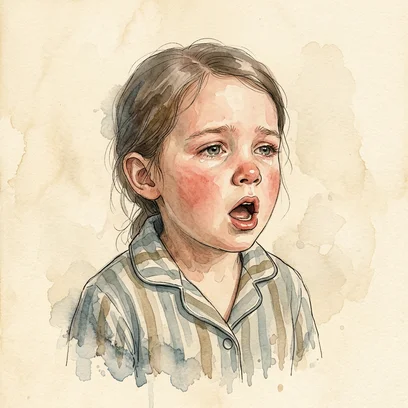
Croupy Cora
Croup vs Epiglottitis: The Barking Cough and the Child You Never Lie Down
Written lecture — video coming
The memory hook
Her cough sounds like a seal barking at midnight — but if she starts drooling and leaning forward, the rules change completely
The story
Cora woke at midnight barking like a seal. In the emergency department the nurse watches closely: barking means croup, but drooling and a tripod lean would change everything.
Cora was a rambunctious toddler whose parents nicknamed her Croupy Cora after her very first winter illness, when her distinctive barking cough startled the entire household awake at two in the morning and never seemed to fully go away each cold season after that. Croup, medically known as laryngotracheobronchitis, is a viral inflammation of the larynx and the subglottic trachea just beneath the vocal cords, and in a small child's already narrow airway, even modest swelling there causes dramatic turbulent airflow, producing the unmistakable barking cough and inspiratory stridor that worsen predictably at night. Cora's parents have learned to recognize her seal-like cough instantly, but this particular winter, an unusually severe episode will test whether they truly understand the difference between ordinary croup and a far more dangerous airway emergency.
Three-year-old Cora wakes at midnight with her characteristic barking cough and audible stridor even while resting quietly in her mother's arms, prompting an urgent trip to the pediatric emergency department. She is alert, making good eye contact, and although clearly uncomfortable, she is able to speak in short sentences between coughing spells and swallows her own saliva without difficulty. Her temperature runs a mild 100.4 degrees Fahrenheit, and her oxygen saturation reads 96 percent on room air. The triage nurse recognizes this classic presentation and moves quickly, mindful that agitation itself can worsen airway narrowing in croup, so she keeps Cora calm and seated comfortably on her mother's lap rather than separating them for a traditional examination table assessment.
While being monitored, Cora's stridor is heard clearly even without a stethoscope, present at rest rather than only with crying, indicating a significant degree of airway narrowing that demands escalating treatment. Her respiratory rate climbs to 36 breaths per minute with mild suprasternal retractions visible with each breath. Crucially, she is not drooling, not refusing to swallow her own saliva, and her voice, though hoarse, is not muffled in the way a swollen epiglottis would produce. This distinction matters enormously, because a bacterial epiglottitis would present instead with drooling, dysphagia, dysphonia and visible distress, the classic four Ds, and would demand the throat never be examined or the child ever laid flat, for fear of triggering complete airway obstruction.
The emergency nurse and physician treat Cora's croup with nebulized racemic epinephrine to rapidly shrink the swollen subglottic tissue, given that her stridor is present even at rest, alongside a single dose of oral dexamethasone to reduce inflammation over the following days. She keeps Cora upright on her mother's lap throughout every intervention, understanding that crying and distress from being forcibly restrained would only worsen the very airway narrowing they are trying to relieve. Cool humidified oxygen is offered as tolerated near her face rather than forced with a tight mask. The nurse carefully avoids ever inspecting Cora's throat with a tongue depressor, a caution that would only be warranted for suspected epiglottitis, and monitors her closely for improvement in stridor and work of breathing after the epinephrine treatment.
The setup
Cora had a runny nose for two days, then woke at midnight with a harsh, barking cough and noisy breathing.
The turn
Her stridor improves with cool mist and a calm position on her mother's lap; crying makes it louder.
The crisis
A child in the next bay has a sudden high fever, drooling, a muffled voice and will only breathe leaning forward on her hands.
The save
Nobody looks in that child's throat. She stays upright on her parent's lap, equipment for an emergency airway comes to the bedside, and the team prepares a controlled intubation.
Already a member? Sign in