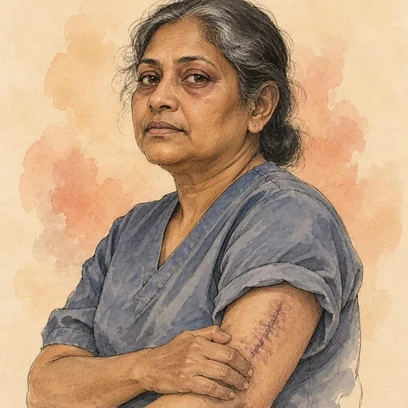
Dialysis Dina
Chronic Kidney Disease & Hemodialysis
Written lecture — video coming
The memory hook
Never take a BP or draw blood from the fistula arm — a thrill and bruit confirm it's still patent
The story
Dina arrives for her regular hemodialysis session with an AV fistula in her left forearm that she guards fiercely from every blood pressure cuff. Today the nurse notices the usual buzzing thrill under her fingertips is gone.
Dina spent thirty years as a meticulous switchboard operator, carefully routing every single call through the exact correct connection without ever crossing a wire, earning her the affectionate nickname Dialysis Dina among her dialysis unit's nursing staff. That fitting nickname now describes her own critical vascular lifeline with striking precision. Years of progressively worsening chronic kidney disease have destroyed her nephrons' ability to filter waste, balance electrolytes, and regulate fluid volume, ultimately requiring hemodialysis three times weekly through a surgically created arteriovenous fistula in her left forearm. Just like her carefully protected switchboard connections, this fragile vascular access must never be compressed, punctured, or disrupted by careless routing of blood pressure cuffs or needles.
Dina has faithfully attended her scheduled hemodialysis sessions for the past two years, carefully guarding her left forearm from every blood pressure cuff and warning every new nurse never to draw blood from that precious limb. Recently, however, a scheduling conflict caused her to miss one entire dialysis session, and over the following two days between treatments, she noticed increasing shortness of breath and swelling around her ankles. She gained nearly four kilograms of retained fluid weight during this brief interdialytic period, and her appetite diminished considerably as uremic toxins accumulated steadily within her bloodstream, unable to be cleared by her severely damaged kidneys.
Arriving late for her rescheduled dialysis session, Dina's laboratory results revealed a critically elevated serum potassium level of 6.2 milliequivalents per liter, and her cardiac monitor displayed unmistakably peaked T waves suggesting dangerous cardiac irritability from severe hyperkalemia. When the nurse attempted her routine pre-dialysis fistula assessment, palpation revealed no thrill whatsoever beneath the skin, and careful auscultation detected no audible bruit over the access site. Dina's forearm felt distinctly cooler than her other arm, and no distal pulse could be palpated, strongly suggesting that her life-sustaining fistula had acutely thrombosed and clotted shut.
The nurse immediately notified the nephrology provider regarding the absent thrill and bruit, recognizing this vascular emergency required urgent intervention to potentially salvage the clotted access before it became permanently unusable. Simultaneously, the team addressed Dina's life-threatening hyperkalemia through emergent administration of intravenous calcium gluconate for cardiac membrane stabilization, followed by insulin and dextrose to temporarily shift potassium intracellularly, while arranging urgent alternative dialysis access. The nurse carefully avoided any further manipulation or repeated palpation of the clotted fistula site, understanding that gentle handling preserved whatever slim chance remained for successful surgical thrombectomy and restoration of blood flow.
The setup
Dina has end-stage chronic kidney disease and relies on hemodialysis three times a week through a left forearm AV fistula.
The turn
Between sessions, Dina gains 4 kg, develops shortness of breath, and her potassium rises to 6.2 mEq/L with peaked T waves on ECG.
The crisis
On assessment, the nurse cannot palpate a thrill or auscultate a bruit over Dina's fistula, and the arm feels cool with no distal pulse.
The save
The nurse immediately notifies the provider, avoids any further manipulation of the site, ensures no BP or venipuncture is ever performed on that arm, and prepares Dina for emergent thrombectomy or new access placement while managing her hyperkalemia.
Already a member? Sign in