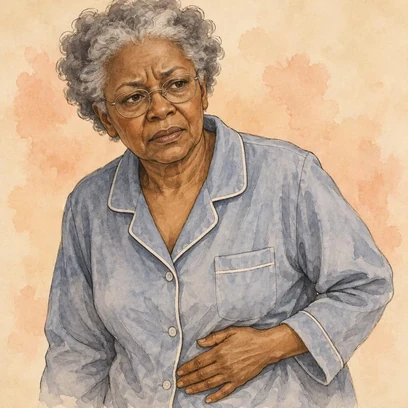
Diverticular Dee
Diverticulitis
Written lecture — video coming
The memory hook
LLQ pain, fever and a change in bowel habits — perforation turns this into peritonitis fast
The story
Dee has had years of mild constipation and occasional cramping in her lower left abdomen that she never mentioned to anyone. Tonight the pain sharpens suddenly, she spikes a fever, and her abdomen feels tender and guarded to the touch.
Dee has spent decades running a small-town bakery famous for its dense, low-fiber white bread rolls, a habit her doctor has gently teased her about for years, dubbing her Diverticular Dee. That teasing nickname now describes the exact pathology quietly developing within her sigmoid colon. Years of a low-fiber diet combined with chronic straining and constipation have gradually weakened areas of her colonic wall, allowing small mucosal pouches called diverticula to herniate outward through weakened muscular layers, particularly within the narrow, high-pressure sigmoid segment. Most of these outpouchings remain silently asymptomatic for years until a hardened piece of stool becomes trapped inside one, triggering localized inflammation, micro-perforation, and the onset of true diverticulitis.
For years, Dee experienced only occasional mild cramping in her lower left abdomen after particularly stressful baking weekends, dismissing it as simple irritable bowel syndrome unrelated to her diet. She rarely incorporated fruits, vegetables, or whole grains into her own meals despite baking bread professionally, and her chronic constipation went largely unaddressed. One evening after closing the bakery early, a steady, gnawing ache settled firmly into her left lower quadrant, accompanied by a noticeable change in her bowel habits alternating between constipation and loose stools. A low-grade fever and mild nausea soon followed, though Dee initially attempted to power through her symptoms with over-the-counter pain relievers.
By the following morning, Dee's condition deteriorated dramatically. Her temperature spiked to 102.6 degrees Fahrenheit, her abdomen became rigid and board-like to palpation, and diffuse rebound tenderness spread far beyond her original left lower quadrant discomfort. Laboratory results revealed a markedly elevated white blood cell count of 16,000 cells per microliter, and emergency imaging confirmed a micro-perforation with localized free air, signaling that one of her inflamed diverticula had ruptured, spilling colonic contents into the peritoneal cavity. The nursing team recognized this constellation of findings as early peritonitis requiring urgent surgical evaluation rather than simple outpatient antibiotic management.
The nurse immediately placed Dee on strict nothing-by-mouth status, initiated intravenous fluids to combat developing sepsis, and administered broad-spectrum intravenous antibiotics per emergency protocol. Enemas, laxatives, and vigorous abdominal palpation were deliberately withheld, since any of these could worsen inflammation or precipitate further perforation within her already compromised bowel wall. Continuous vital sign monitoring tracked for any signs of worsening peritonitis or hemodynamic instability while the surgical team prepared Dee for possible CT-guided percutaneous drainage or emergency bowel resection, depending on how her condition evolved over the following hours of close observation.
The setup
Dee, 68, has a long history of a low-fiber diet and chronic constipation, with occasional mild LLQ cramping she attributes to 'irritable bowel.'
The turn
Dee develops steady left lower quadrant pain, low-grade fever, and a change in bowel habits with nausea.
The crisis
Dee's fever rises to 39.2°C, her WBC count climbs to 16,000/mcL, and her abdomen becomes rigid with rebound tenderness, suggesting perforation.
The save
The nurse keeps Dee NPO, starts IV fluids and antibiotics, monitors vital signs closely, and prepares her for possible CT-guided drainage or emergency surgery if perforation is confirmed.
Already a member? Sign in