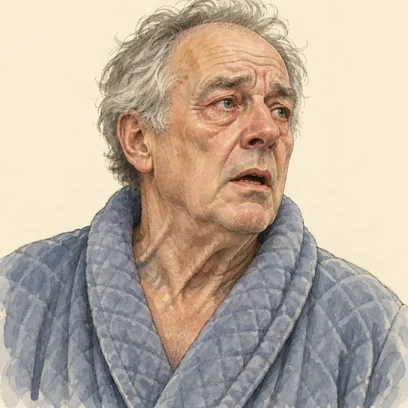
Failing Frank
Heart Failure
Written lecture — video coming
The memory hook
Left = lungs, right = rest of the body; weigh daily
The story
Frank sleeps on three pillows and still wakes gasping at 2 a.m. His scale tells the story days before his lungs do.
Frank Miller is a retired 68-year-old train conductor. Dependable and methodical, he always kept his locomotive running on schedule, but his own internal engine is sputtering. Failing Frank earned his clinical moniker because his ventricles can no longer effectively pump forward the blood volume his body demands. When Frank's left ventricle falters, hydrostatic pressure surges backwards into the pulmonary circulation, drenching his alveoli with backed-up fluid. Meanwhile, as the right ventricle also weakens against elevated pressures, blood dams backward into the systemic circulation, engorging peripheral veins and organs. Frank’s heart cannot generate adequate forward cardiac output, triggering neurohormonal cascades that mistakenly retain fluid and overload an already exhausted pump. For months, he dismissed his flagging stamina as normal aging, unaware that progressive cardiac failure was taking hold.
Frank’s cardiac decline began decades earlier, rooted in chronic untreated hypertension and an anterior myocardial infarction that left a large portion of his ventricular wall scarred and akinetic. His left ventricle dilated and stiffened, forcing compensatory remodeling that eventually exhausted his myocardial reserve. Early warning signs accumulated quietly before demanding attention. Frank found himself needing two, then three firm pillows to prop his chest upright at night to avoid a suffocating sensation, classic orthopnea. Paroxysmal nocturnal dyspnea soon shattered his rest, jolting him awake gasping for air at two in the morning. By afternoon, his work boots bit painfully into his ankles, leaving deep pitting impressions as right-sided venous pooling mounted. Unexplained daytime fatigue, nocturia, and subtle exertional dyspnea signaled that his cardiovascular compensation was completely breaking down.
The tipping point arrived after Frank consumed a high-sodium dinner, triggering explosive intravascular fluid retention. Within three days, his bathroom scale registered an alarming five-pound gain. Frank arrived at the emergency department in florid respiratory distress, leaning forward in a tripod position with an oxygen saturation of eighty-six percent on room air. Auscultation revealed coarse bilateral crackles extending halfway up his lung fields and an audible third heart sound, accompanied by prominent jugular venous distention and three-plus pretibial edema. He coughed up frothy, pink-tinged sputum, a hallmark of flash pulmonary edema. Emergency diagnostic labs confirmed catastrophic failure: his B-type natriuretic peptide skyrocketed to fourteen hundred picograms per milliliter, a bedside echocardiogram demonstrated an ejection fraction of twenty-five percent, and a portable chest radiograph revealed profound cardiomegaly with dense pulmonary vascular congestion.
The nurse executed critical life-saving interventions in rapid, methodical order. First, the nurse positioned Frank in high-Fowler’s with his legs dangling dependent over the bedside, instantly reducing venous return to alleviate cardiac preload. High-flow oxygen via a non-rebreather mask was applied to reverse profound hypoxemia. The nurse then administered intravenous furosemide forty milligrams over two minutes to initiate rapid diuresis, while withholding his routine oral beta-blocker to prevent further negative inotropic collapse during acute decompensation. The nurse placed an indwelling catheter to measure strict hourly urine output, continuously monitoring telemetry for dysrhythmias and checking serum potassium levels to avoid diuretic-induced hypokalemia. Rapid intravenous fluid boluses and supine positioning were strictly contraindicated, as either action would flood Frank’s remaining functional lung tissue and precipitate fatal cardiac arrest.
The setup
Years of hypertension and a previous MI stiffen and weaken his left ventricle.
The turn
He needs three pillows to sleep, wakes gasping at night, and his shoes stop fitting.
The crisis
Five pounds gained in three days, crackles to mid-lung, pink frothy sputum and SpO₂ 86%.
The save
High-Fowler's with legs dependent, oxygen, IV furosemide, then daily weights, sodium restriction and medication teaching at discharge.
Already a member? Sign in