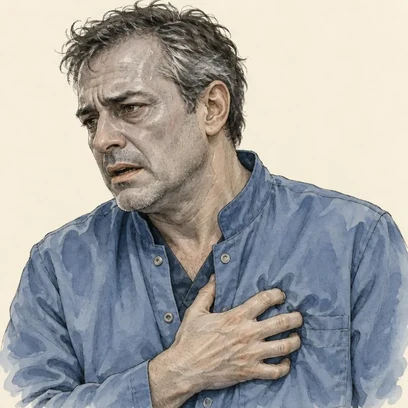
Infarcting Ivan
Myocardial Infarction
Written lecture — video coming
The memory hook
Crushing pain unrelieved by rest — MONA, then reperfusion
The story
Ivan feels an elephant sit on his chest while shoveling snow. The pain runs down his left arm, he sweats through his coat, and the muscle of his heart begins to die minute by minute.
Ivan is a fifty-eight-year-old retired diesel mechanic who prides himself on never calling in sick and handling every problem with sheer grit. Known to his neighbors as Infarcting Ivan, his tragic nickname captures the cellular catastrophe unfolding deep within his chest, where myocardial tissue suffocates and undergoes irreversible ischemic necrosis. An infarction means tissue death from an abrupt lack of oxygenated blood supply, exactly what happens when one of Ivan’s major coronary arteries suddenly clamps shut behind a thrombotic blockade. Beneath his grease-stained flannel shirt, his left anterior descending and right coronary arteries have spent decades narrowing. Ivan believes he is indestructible, but myocardial cells can survive severe ischemia for only twenty minutes before permanent necrosis begins to consume his working ventricular myocardium.
Ivan’s cardiac crisis did not appear out of nowhere; it brewed across twenty years of a pack-a-day smoking habit, untreated hypertension, and a lipid profile loaded with low-density lipoproteins. Soft atheromatous plaques steadily lined the intima of his coronary vessels, narrowing luminal diameter while fibrous caps strained against daily pressure surges. In recent months, Ivan brushed off intermittent bouts of stable angina, chalking up the chest heaviness after climbing stairs to simple aging because five minutes of rest always made it fade. But on a freezing January dawn while shoveling heavy snow, the intense sympathetic surge ruptured a fragile plaque. Platelets immediately aggregated over the exposed lipid core, activating the clotting cascade to form an occlusive thrombus that rest could no longer relieve.
The crisis strikes like an elephant landing squarely across Ivan’s sternum. The crushing substernal pressure radiates violently up into his jaw and down his left arm, leaving him drenched in cold diaphoresis with severe nausea and a suffocating sense of impending doom. He pops three sublingual nitroglycerin tablets five minutes apart, but the relentless ache persists past thirty minutes. In the emergency department, his 12-lead electrocardiogram reveals prominent ST-segment elevations in leads II, III, and aVF, confirming an acute inferior STEMI. His heart rate drops to 52 beats per minute, and blood pressure plummets to 88/54 mmHg. Serum labs solidify the diagnosis with a high-sensitivity cardiac troponin I level spiking to 2.45 ng/mL, drastically above the normal reference range of under 0.04 ng/mL.
The nurse immediately initiates rapid cardiac rescue, placing Ivan on a continuous cardiac monitor, establishing two large-bore intravenous lines, and administering 324 milligrams of chewable aspirin to inhibit further platelet aggregation. Because Ivan’s pulse oximetry reads 94 percent on room air, supplemental oxygen is appropriately withheld to prevent hyperoxic coronary vasoconstriction. Recognizing the ST elevation in inferior leads II, III, and aVF alongside severe hypotension, the nurse astutely holds sublingual nitroglycerin and morphine, which are contraindicated due to the high risk of catastrophic preload collapse in right ventricular involvement. Instead, the nurse administers an intravenous normal saline bolus to sustain preload while alerting the catheterization team. The ultimate priority is rapid reperfusion, transporting Ivan to the cardiac catheterization laboratory to achieve door-to-balloon angioplasty within ninety minutes.
The setup
Smoking, high cholesterol and a family history build plaque for twenty years. This morning one plaque ruptures.
The turn
Crushing substernal pressure radiating to the jaw and left arm, unrelieved by rest or three nitroglycerin tablets.
The crisis
ST elevation in leads II, III and aVF. Troponin rising. Heart rate 52 with hypotension.
The save
Chewable aspirin, cardiac monitoring, IV access, and straight to the cath lab — door-to-balloon under 90 minutes.
Already a member? Sign in