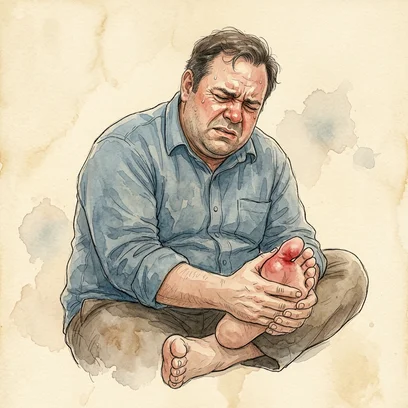
Gout Gus
Gout: Uric Acid Crystals, the Angry Big Toe & Purine Teaching
Written lecture — video coming
The memory hook
He woke at 2 a.m. with a big toe so hot and swollen the bedsheet felt like a blade
The story
Gus wakes at 2 a.m. with searing pain in his right great toe. It is red, hot and so tender he cannot bear the weight of the sheet.
Gus was the undisputed champion of his neighborhood weekend barbecues, famous for piling his plate with organ meats, shellfish and more than a few cold beers while bragging that nothing ever slowed him down, a habit that eventually earned him the nickname Gout Gus once his own biochemistry finally caught up with his appetite. Uric acid, the end product of purine metabolism, accumulates in the bloodstream when the body either overproduces it or the kidneys fail to excrete it efficiently enough, and Gus's diet and beer consumption pushed both problems simultaneously. When serum uric acid climbs high enough, needle-sharp monosodium urate crystals precipitate out of solution into the body's cooler peripheral joints, and no joint is cooler or more classically affected than the great toe.
One night after an especially indulgent barbecue loaded with shellfish and several beers, Gus goes to bed feeling perfectly fine, only to wake abruptly at two in the morning with his right great toe throbbing so violently that even the weight of the bedsheet against it feels unbearable, like a blade dragging across raw skin. He cannot bear to stand on it, and by the time his wife helps him to the emergency department, the joint has become visibly red, hot to the touch, and dramatically swollen compared to its normal size. He insists he has never felt pain like this in his life, and the triage nurse immediately suspects an acute gout flare given the location, timing and rapid onset.
Joint aspiration confirms needle-shaped, negatively birefringent monosodium urate crystals under polarized light, and Gus's serum uric acid returns at 9.8 mg/dL, well above the normal range of roughly 3.5 to 7.2 mg/dL, though the physician reminds the team that levels can occasionally appear normal even during an acute flare. His toe has swollen to nearly double its usual size, the overlying skin appears tight and shiny, and his pain rating sits at a 9 out of 10 despite his reluctance to let anyone even approach the bed. He also mentions this is his third similar episode in eighteen months, raising concern about eventual tophi formation and long-term urate nephropathy if his hyperuricemia continues unaddressed.
The nurse's first priority is protecting the inflamed joint from any additional pressure, using a bed cradle to keep even the sheets from touching Gus's toe, and elevating the extremity while promptly administering the ordered anti-inflammatory medication, in this case colchicine, to calm the acute crystal-driven inflammation. She is careful not to start allopurinol during this acute attack, knowing urate-lowering therapy can actually worsen an ongoing flare and should only begin once symptoms resolve. She encourages Gus to drink two to three liters of fluid daily once his flare improves, to help flush uric acid and prevent kidney stone formation, and she begins purine-focused dietary teaching, targeting his beloved organ meats, shellfish, sardines and beer as the clearest culprits behind his repeated flares.
The setup
Gus enjoys beer, steak and shellfish, takes a thiazide diuretic for blood pressure, and drinks little water.
The turn
He wakes overnight with an intensely painful, red, hot, swollen right great toe that cannot tolerate touch.
The crisis
Gus tries to walk it off, keeps drinking beer, and by day three he has a fever and firm white nodules on his ear.
The save
The acute flare is treated with anti-inflammatory therapy, the joint is rested and elevated with a bed cradle, and allopurinol is started only after the attack settles.
Already a member? Sign in