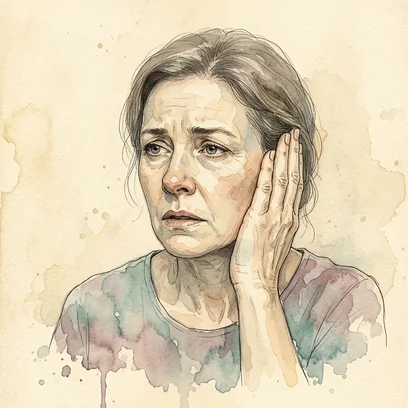
Meniere Mira
Meniere's Disease: Vertigo, Tinnitus & Hearing Loss
Written lecture — video coming
The memory hook
The room spins without warning, one ear roars, and she has to grab the wall to stay upright
The story
Mira is halfway across the kitchen when the room lurches sideways. Her right ear roars, she cannot hear her daughter, and she drops to the floor to stop the spinning.
Mira spent years as a beloved symphony violinist known for her perfect pitch and unshakable stage presence, which made it all the more devastating when her own inner ear betrayed her, earning her the nickname Meniere Mira among concerned bandmates once the room around her began spinning without warning. Endolymphatic hydrops, an abnormal accumulation of fluid within the inner ear, distends the delicate membranous labyrinth and disturbs both the vestibular and cochlear systems housed there. Pressure changes distort the sensitive hair cells responsible for balance and hearing, producing episodic rotational vertigo with nausea, fluctuating low-frequency hearing loss, tinnitus, and a distinct sensation of fullness, usually confined to just one ear. Because Mira's attacks arrive entirely without warning, the greatest danger nurses must anticipate is not the vertigo itself, but the injury she could suffer from a sudden, unpredictable fall.
During a rehearsal for an upcoming performance, Mira lowers her violin between movements and suddenly feels the entire concert hall lurch sideways as though the floor itself has tilted beneath her chair. A ringing roar fills her left ear, and within seconds she is gripping the music stand with both hands, nauseated and terrified she might vomit in front of the entire orchestra. Her conductor rushes to steady her as she slides carefully to the floor rather than risk collapsing, and colleagues later describe watching her face go pale as she pressed her palm firmly against her left ear, insisting everything sounded muffled and strangely underwater.
In the emergency department, audiometry confirms fluctuating low-frequency sensorineural hearing loss in Mira's left ear, and she reports the attack lasted nearly ninety minutes before the spinning finally subsided enough for her to sit upright without vomiting again. Her tinnitus persists as a constant low roar even hours later, and she describes recurring episodes of aural fullness that have been building for the past several months, episodes she previously dismissed as stress from an approaching concert season. The physician explains this classic triad of vertigo, tinnitus, and fluctuating unilateral hearing loss, together lasting well beyond mere seconds, points clearly toward Meniere's disease rather than the brief positional vertigo she initially suspected.
The nurse's immediate priority during any attack is preventing injury, ensuring Mira is safely seated or lying down the instant vertigo begins and keeping her call light within constant reach whenever she is hospitalized for observation. She assists with all ambulation during active symptoms rather than allowing Mira to attempt walking alone, and she administers the ordered antihistamine and antiemetic promptly to control the nausea and vestibular symptoms. Once the acute episode passes, she begins thorough dietary teaching centered on strict sodium restriction, since reducing dietary sodium directly helps limit endolymph volume, and she counsels Mira to avoid caffeine, alcohol and nicotine, all recognized triggers, while never driving, climbing, or swimming alone given the unpredictable nature of her attacks.
The setup
Mira notices intermittent fullness and a low roaring sound in her right ear, with hearing that comes and goes.
The turn
Without warning the room begins spinning violently for two hours, with nausea and vomiting.
The crisis
An attack hits while Mira is on the stairs and she nearly falls down a full flight.
The save
Mira learns to lie still in a quiet, dark room during attacks, follows a low-sodium diet with her diuretic, and cuts caffeine, alcohol and nicotine.
Already a member? Sign in