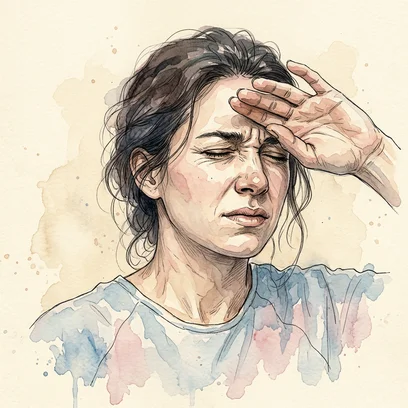
Meningitis Mia
Bacterial Meningitis: Stiff Neck, Droplet Precautions & Rapid Antibiotics
Written lecture — video coming
The memory hook
A college dorm, a fever, and a neck too stiff to touch her chin to her chest
The story
Mia, a 19-year-old dorm resident, spikes a fever of 103F with a pounding headache. She cannot bend her chin to her chest, the lights hurt, and she is becoming confused.
Mia lived for her freshman year of college, cramming into a crowded dorm suite with five roommates and earning the nickname Meningitis Mia only in retrospect, once everyone realized how quickly close, shared living quarters had turned a single sore throat into a shared nightmare. Bacteria reach the subarachnoid space, often through respiratory droplet spread exactly like the kind exchanged constantly in packed dorm hallways, and trigger intense inflammation of the meninges surrounding the brain and spinal cord. That inflammatory exudate raises intracranial pressure, irritates the cranial nerves, and stretches pain-sensitive structures, producing the classic triad of headache, photophobia and a stiff, resistant neck. Because Neisseria meningitidis can also seed the bloodstream causing septic shock, Mia's story became the cautionary tale every dorm resident advisor now tells during move-in week.
Mia wakes one morning with what she assumes is simply a brutal hangover headache, but by that afternoon overhead fluorescent lights in the lecture hall feel unbearably painful, forcing her to squint and eventually leave class early. Her roommate finds her curled in bed that evening, feverish and irritable, unable to tolerate the dorm room lamp being switched on. When her roommate playfully tries to get her moving for dinner and tugs gently at her arm to sit up, Mia cries out in pain and cannot bring her chin anywhere close to her chest, the stiffness radiating sharply down her neck. Recognizing this combination as more than a bad hangover, the roommate calls campus health services immediately.
By the time Mia arrives at the emergency department, her temperature has spiked to 103.2°F, her heart rate has climbed to 118 beats per minute, and a nurse performing a neurological assessment finds both a positive Kernig's sign and a positive Brudzinski's sign confirming meningeal irritation. A lumbar puncture reveals cloudy cerebrospinal fluid with a glucose of only 22 mg/dL, far below normal, alongside markedly elevated protein and a neutrophil-predominant cell count, all consistent with bacterial rather than viral meningitis. Moments later, a nurse doing a full skin assessment discovers a scattering of small, non-blanching purpuric spots developing across Mia's lower legs, an alarming sign that the infection may already be seeding her bloodstream toward meningococcemia.
The nurse's very first action is placing Mia on droplet precautions immediately, protecting the entire dorm-adjacent unit before another single diagnostic result even returns, because delay in isolation and antibiotics measurably increases mortality in bacterial meningitis. Intravenous antibiotics are started emergently right after cultures are drawn, without waiting for laboratory confirmation. The nurse elevates the head of Mia's bed to roughly 30 degrees with her neck kept neutral to support intracranial pressure control, dims the room and clusters all care to minimize painful photophobic and auditory stimulation, and closely monitors that purpuric rash for any spread suggesting worsening septicemia. She also promptly notifies public health so Mia's close dorm contacts can receive prophylactic antibiotics before anyone else falls ill.
The setup
Mia lives in a crowded college dorm and skipped her meningococcal vaccine.
The turn
She develops a fever of 103F, a severe headache, photophobia and a neck so stiff she cannot flex it.
The crisis
Mia becomes confused and a purple non-blanching rash spreads across her trunk.
The save
Droplet precautions are started on arrival, cultures and lumbar puncture are obtained, and IV antibiotics are given immediately. Close contacts get prophylaxis.
Already a member? Sign in