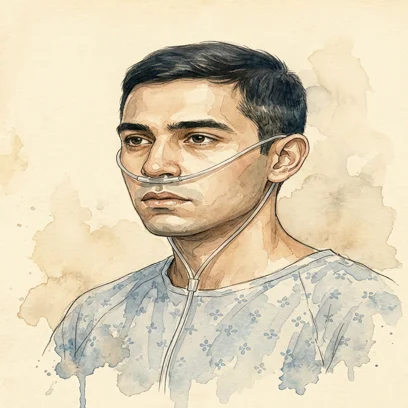
Oxygen Omar
Oxygen Delivery Devices: Matching the Mask to the Need — and Fire Safety
Written lecture — video coming
The memory hook
The right oxygen device is not the biggest one — it is the one that matches the liters, the diagnosis and the risk
The story
Four devices hang on the wall. The question is never which one looks strongest — it is which one fits the client in front of him.
Omar worked for years as a respiratory therapist known for his blunt insistence that oxygen is a drug with a dose, not a comfort measure to be cranked up whenever a patient felt short of breath. His coworkers nicknamed him Oxygen Omar because he could recite the delivered percentage of every device on the unit from memory, correcting anyone who casually called a nasal cannula and a non-rebreather interchangeable. His philosophy rested on a key physiological truth: low-flow devices like the nasal cannula mix supplemental oxygen with room air, so the actual concentration a client receives shifts unpredictably with breathing pattern, while high-flow devices and reservoir masks deliver a far more precise, dependable fraction, a distinction that becomes life-or-death in clients with chronic lung disease.
Omar is assigned to a client with longstanding chronic obstructive pulmonary disease who arrives short of breath with an oxygen saturation of 86 percent on room air. The provider orders oxygen via Venturi mask targeting a saturation between 88 and 92 percent, deliberately conservative because this client chronically retains carbon dioxide and relies on a slightly lowered oxygen level to maintain the drive to breathe. A well-meaning family member, alarmed by the low saturation reading on the monitor, quietly turns the flow rate up and swaps the mask for a non-rebreather sitting unused in the room, believing more oxygen must surely be better. Omar returns from another client's room to find the change already made and immediately senses the danger building in that decision.
Within the hour, the client becomes increasingly difficult to arouse, his speech slurring as though intoxicated, and his respiratory rate drops from 22 down to just 9 breaths per minute despite his oxygen saturation now reading a falsely reassuring 98 percent. An arterial blood gas drawn urgently reveals a markedly elevated carbon dioxide level of 68 millimeters of mercury alongside a pH of 7.28, confirming worsening respiratory acidosis. Omar recognizes this constellation immediately as carbon dioxide narcosis, the dangerous suppression of the hypoxic drive to breathe that occurs when a chronic retainer receives too much supplemental oxygen. The rising drowsiness, not the saturation number, is the true emergency finding, and it demands intervention before the client's respiratory effort fails completely.
Omar immediately reduces the oxygen back down to the ordered Venturi mask setting delivering a precise, lower percentage, understanding that this device's design prevents the guesswork of a nasal cannula while still avoiding the excessive concentration of a non-rebreather. He stimulates the client, reassesses respiratory rate and level of consciousness closely, and notifies the provider of the arterial blood gas results and the family's well-intentioned interference. He educates the family firmly that oxygen flow must never be adjusted without a nurse's instruction, no matter how frightening a saturation number looks on the monitor. He documents the entire sequence and titrates oxygen going forward strictly to the ordered saturation target rather than to the highest achievable number.
The setup
A client with COPD becomes short of breath, and a nurse reaches for the highest-flow mask on the shelf.
The turn
Omar checks the reservoir bag on the non-rebreather before it ever touches a face.
The crisis
A visitor lights a cigarette in a room with an oxygen source running.
The save
The flow is titrated to the client's saturation, humidity is added for the higher rate, and the skin behind the ears is padded.
Already a member? Sign in