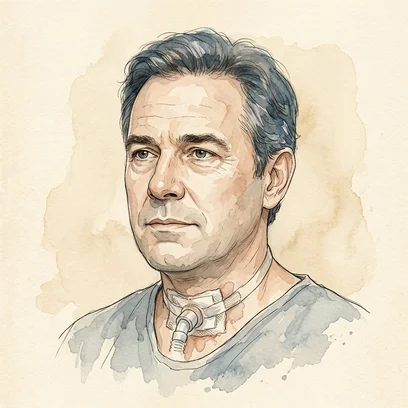
Trach Tomas
Tracheostomy & Suctioning Safety: Oxygenate First, Suction Out Only
Written lecture — video coming
The memory hook
His secretions are thick, his saturation is dropping, and the safest suction is the shortest one
The story
Tomas's breathing turns gurgly and his oxygen saturation slips to 88%. The nurse reaches for suction — and follows every step in order.
Tomas is a retired opera singer whose booming baritone once filled concert halls, now living with a permanent tracheostomy after a severe laryngeal cancer required total laryngectomy, a cruel irony his nurses gently acknowledge while caring for the very airway that silenced his singing voice. His tracheostomy bypasses his upper airway entirely, meaning the air he breathes is no longer naturally warmed, humidified, or filtered the way it once was passing through his nose and pharynx. Without that natural conditioning, Tomas's secretions thicken considerably, requiring more frequent suctioning to keep his airway clear. Yet suctioning itself is a double-edged intervention: while it removes dangerous secretions, it simultaneously removes oxygen from his airway and stimulates his vagus nerve, meaning prolonged or repeated suction passes risk producing hypoxemia and bradycardia rather than helping him at all.
Tomas lives at home with his tracheostomy and manages his own care independently most days, but he is admitted to the hospital with a respiratory infection that has thickened his secretions dramatically beyond his usual baseline. His nurse notices during morning assessment that his secretions have become tenacious and difficult to clear even with his usual home suctioning technique, and his oxygen saturation, typically a stable 96 percent on room air, has been trending downward toward 91 percent over the past several hours. Tomas, an experienced self-advocate after years of living with his tracheostomy, tells the nurse plainly that he feels like he simply cannot get enough air no matter how hard he tries to cough and clear his airway himself.
During a suctioning attempt later that shift, the nurse becomes distracted helping a colleague and holds continuous suction for nearly twenty-five seconds rather than the recommended maximum, watching Tomas's oxygen saturation plummet rapidly to 84 percent on the monitor while his heart rate drops from 88 down to 58 beats per minute. Tomas's face visibly pales and he begins gesturing urgently for the nurse to stop. This dangerous combination of hypoxemia and vagally mediated bradycardia is a textbook consequence of an overly prolonged suction pass, and it demonstrates exactly why the timing and technique of tracheostomy suctioning carries as much clinical weight as the decision to suction at all.
The nurse immediately withdraws the catheter and applies 100 percent supplemental oxygen, hyperoxygenating Tomas thoroughly before considering another attempt. She waits until his saturation climbs back above 95 percent and his heart rate normalizes before resuming, and when she does suction again she limits the pass strictly to under fifteen seconds, applying suction only during withdrawal of the catheter rather than on insertion. Between passes she reoxygenates him fully again, and she limits the total episode to no more than three passes to avoid cumulative mucosal trauma and repeated oxygen desaturation. She keeps a spare tracheostomy tube and obturator visible at his bedside at all times, reinforcing the ever-present possibility of accidental decannulation.
The setup
After prolonged ventilation, Tomas receives a tracheostomy and is learning to live with it.
The turn
His breathing becomes wet and rattly, and his saturation drifts down.
The crisis
Mid-suction his saturation falls further and his heart rate drops. The nurse withdraws the catheter and re-oxygenates.
The save
Tomas is hyperoxygenated, suctioned only on withdrawal, allowed to rest, and his stoma care is done with a spare tube ready at the bedside.
Already a member? Sign in