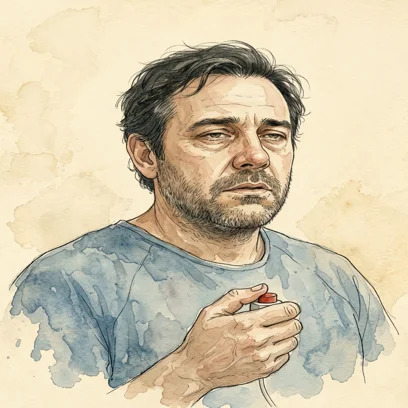
PCA Pablo
PCA & Opioid Safety: Only the Patient Presses the Button
Written lecture — video coming
The memory hook
His daughter pressed the button while he slept, because she loves him — and that is exactly how an overdose happens
The story
Pablo is deeply asleep. His hand is off the button — but someone else's hand is on it.
Pablo, a warm and stoic construction worker recovering from a major orthopedic surgery, earned his nickname from the nursing staff for how meticulously he tracked his own pain relief using his patient-controlled analgesia pump, pressing the button himself the instant he felt discomfort building rather than waiting for pain to become unbearable. His nurses admired his discipline, unaware that his careful self-dosing was actually the built-in safety feature of the entire system working exactly as designed. Patient-controlled analgesia relies on a simple physiological safeguard: a client becoming oversedated from too much opioid will naturally fall asleep and simply stop pressing the button, preventing further accumulation. That protective loop only functions, however, if the client and only the client is the one controlling the dose.
One evening, Pablo's exhausted adult daughter arrives to visit after a long day and finds her father sleeping soundly, his brow furrowed as though still uncomfortable. Believing she is helping him rest more peacefully, she quietly presses the PCA button herself twice while he sleeps, unaware that this simple act of love completely bypasses the very safety mechanism the device depends upon. Because Pablo is asleep and not the one initiating each dose, opioid begins accumulating in his system without any of the natural feedback that would normally stop it. The night nurse, unaware of the daughter's actions, continues routine monitoring, not yet suspecting that anything is amiss with a client who appears simply to be resting comfortably.
During a scheduled check two hours later, the nurse finds Pablo profoundly difficult to arouse, responding only to vigorous sternal rub with a weak groan before drifting back into unresponsiveness. His respiratory rate has fallen to just 6 breaths per minute, shallow and irregular, and his oxygen saturation reads 84 percent on room air. His pupils are notably pinpoint, and his skin feels cool and slightly diaphoretic to the touch. The nurse immediately recognizes this constellation of profound sedation, bradypnea, and pinpoint pupils as classic opioid-induced respiratory depression, made far more dangerous by the fact that it developed silently while everyone believed Pablo was simply enjoying restful, pain-free sleep after diligently managing his own analgesia all day.
The nurse responds immediately by stopping the PCA infusion and vigorously stimulating Pablo while calling for help. She applies supplemental oxygen and prepares naloxone at the bedside, administering it in small, carefully titrated doses to reverse the respiratory depression without completely eliminating his pain control. She reassesses his respiratory rate and level of consciousness continuously as the naloxone takes effect, remaining alert for the medication's shorter duration compared to the opioid, which can allow sedation to return once it wears off. Once Pablo is stable and alert again, she gently but firmly explains to his tearful daughter that only the patient may ever press the PCA button, no matter how much someone else wishes to ease his suffering, because that single boundary is what keeps the entire safety system intact.
The setup
Pablo returns from surgery with a PCA pump, and the nurse teaches him to press whenever pain begins to build.
The turn
His daughter, trying to keep him comfortable, presses the button every time he winces in his sleep.
The crisis
He becomes hard to rouse, his breathing slows to 8 shallow breaths a minute, and his saturation drops.
The save
The PCA is stopped, he is stimulated and given oxygen, naloxone is prepared, and the family is retaught.
Already a member? Sign in