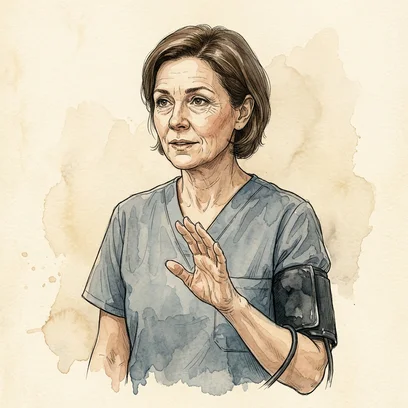
Pressure Pam
Antihypertensive Classes: Orthostatic Safety and Client Teaching
Written lecture — video coming
The memory hook
Every blood pressure pill shares one teaching point — stand up slowly, and never stop it because you feel fine
The story
Her patient feels fine — which is exactly why he stopped taking the pills. Pam's whole job is the teaching that keeps him on them, safely.
Pam spent her nursing career on a busy cardiology step-down unit, so thoroughly devoted to teaching every hypertensive client about their new medications that patients nicknamed her Pressure Pam for how relentlessly she circled back to blood pressure safety before any discharge. Pam knew that antihypertensive medications lower blood pressure through wildly different mechanisms, some reducing circulating volume, others slowing the heart rate, relaxing blood vessels, or blocking hormonal signals that constrict arteries, yet all of them share one dangerous consequence in common: they blunt the body's normal compensatory response to standing up. Because hypertension itself typically causes no symptoms at all, Pam also knew her clients were tempted to stop their pills the moment they felt fine, a decision that quietly sets the stage for a stroke months or years down the road.
Pam is assigned to discharge teaching for four clients newly started on different antihypertensive classes: one on an ACE inhibitor, one on a beta blocker, one on a calcium channel blocker, and one on a thiazide diuretic. Each client is eager to go home and none of them report feeling particularly unwell, which worries Pam more than if they had complained of symptoms, since it means none of them feel any internal pressure to keep taking a medication that seems unnecessary. She sits with each one individually, reviewing not just how to take the pill but what warning signs demand attention and, critically, why stopping the medication abruptly could be just as dangerous as never starting it at all.
During her assessment, the ACE inhibitor client mentions a nagging dry cough that started about a week after beginning the medication, initially blamed on a lingering cold. The beta blocker client's morning heart rate has been trending down to 52 beats per minute with occasional lightheadedness on standing, and his blood pressure reads 96/58 in clinic. The calcium channel blocker client shows new bilateral ankle swelling that appeared over the past several days. Most alarming of all, the thiazide diuretic client returns two days later reporting sudden facial swelling and lip fullness that appeared within hours, a presentation Pam recognizes could actually reflect a missed cross-reaction rather than the diuretic itself, prompting her to review the full medication list immediately.
Pam addresses each finding according to its true danger level. She reassures the ACE inhibitor client that the dry cough is a known class effect, not an infection, but still notifies the provider so an ARB substitution without the cough can be considered. She holds the beta blocker given the heart rate under 60 and systolic pressure near 96, reporting this to the provider rather than administering the next dose blindly, while emphasizing that beta blockers must never be stopped abruptly due to rebound hypertension and angina risk. She documents the calcium channel blocker's peripheral edema as an expected, monitorable effect. Recognizing facial and lip swelling as angioedema, a true emergency most classically tied to ACE inhibitors, Pam holds the drug immediately and ensures it is never restarted, escalating urgently for airway monitoring.
The setup
A newly diagnosed client says he has no symptoms and does not see the point of daily pills.
The turn
He starts a thiazide and reports leg cramps and unusual fatigue.
The crisis
He stands up quickly from the chair, goes pale and nearly falls.
The save
Pam sets up a pill organizer, a home cuff and a plan for the dry cough he might get from the new ACE inhibitor.
Already a member? Sign in