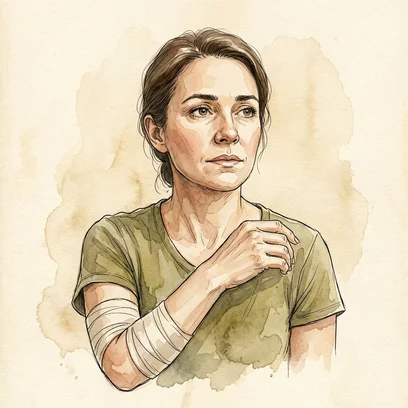
Phantom Petra
Amputation Care: The Limb That Is Gone but Still Hurts
Written lecture — video coming
The memory hook
Phantom pain is real nerve pain — treat it, never dismiss it
The story
Petra's foot aches in the night though the foot is gone — and her nurse treats that pain like any other, because the nerves still carry it.
Petra earned her nickname from her grandchildren after she began describing, quite matter-of-factly, that her amputated leg still itched and ached exactly where her foot used to be, a sensation she insisted felt as real and as maddening as any pain she had ever known. Petra had lost her leg below the knee after years of progressive peripheral vascular disease finally led to irreversible tissue death, and though the limb itself was gone, her sensory cortex and the severed peripheral nerves that once served it continued firing signals mapped to that now-absent foot. This is genuine neuropathic pain, not imagination or grief dressed up as sensation, and Petra's calm insistence that her missing limb was truly hurting becomes the perfect anchor for a phenomenon nurses must never dismiss as psychological.
Petra is recovering on the surgical unit two days after her below-knee amputation, a procedure necessitated by an unsalvageable arterial ulcer that had progressed to gangrene despite months of wound care attempts. Her surgical team has emphasized close monitoring of her residual limb for hemorrhage and infection during this fragile early postoperative period, and a tourniquet remains readily available at her bedside in case of sudden bleeding. Petra's nurse has also begun teaching proper positioning to prevent hip flexion contracture, since prolonged elevation or sitting with the knee bent can permanently shorten the muscles Petra will need for future prosthetic fitting and rehabilitation. Petra herself seems physically stable but increasingly distressed by sensations she cannot make sense of.
On the evening of postoperative day two, Petra rings her call bell repeatedly, describing a burning, cramping sensation radiating through her missing foot that she rates as eight out of ten, insisting her toes feel curled painfully even though they no longer exist. A well-meaning float nurse initially tells Petra the pain cannot be real since the limb is gone, leaving Petra tearful and reluctant to report further symptoms. Meanwhile, her residual limb circumference has increased slightly from 34 to 36 centimeters, suggesting developing edema, though the dressing remains dry without frank bleeding. Petra also admits she has been avoiding her prescribed prone positioning sessions because sitting with her knee flexed feels more comfortable, unknowingly setting herself up for a hip contracture.
Petra's regular nurse intervenes decisively, first validating that phantom limb pain is well-documented, genuine neuropathic pain deserving of real treatment rather than dismissal. She administers the prescribed gabapentin for nerve pain, explains that mirror therapy and other adjuncts can supplement pharmacologic treatment, and documents Petra's pain thoroughly rather than minimizing it in the chart. She measures and records the residual limb circumference to track the developing edema, reinforces the importance of prone positioning several times daily to prevent hip flexion contracture, and gently corrects the earlier misinformation Petra received. She also opens space for Petra to process grief and body image concerns, recognizing that emotional support is as essential to recovery as any physical intervention.
The setup
On the first day after a below-knee amputation, the residual limb is elevated on a pillow.
The turn
Petra reports burning pain in the foot that was amputated and is embarrassed to say so.
The crisis
Two weeks later she has been lying with a pillow under her knee, and her hip will no longer fully straighten.
The save
Pillows come out, prone time begins, the figure-eight wrap shapes the limb, and gabapentin calms the phantom burning.
Already a member? Sign in