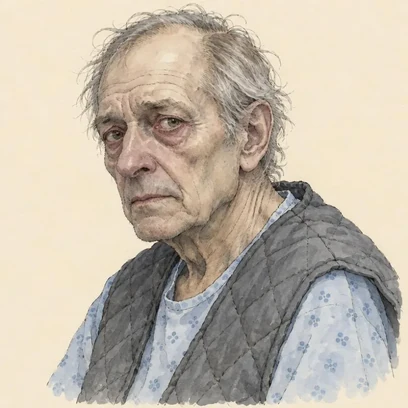
Pumpless Paul
Cardiogenic Shock
Written lecture — video coming
The memory hook
Pump fails: cold, clammy, crackles, high filling pressures
The story
Paul's pump loses half its muscle in a single morning. The tank is full but nothing circulates — his lungs fill from behind while his fingertips go grey.
Paul Henderson spent thirty-five years working as a master pump mechanic at the municipal water treatment facility, proud that no valve ever failed on his watch. At fifty-eight, his meticulous nature earned him the nickname Pumpless Paul when his own primary pump suffered a catastrophic breakdown. In cardiogenic shock, the heart experiences severe pump failure where the left ventricle loses its mechanical power to circulate forward blood flow. The reservoir is brimming, yet nothing moves into systemic circulation. Instead of perfusing Paul's brain and vital organs, the high hydrostatic pressure backs up directly into the pulmonary vascular bed, drowning his lungs while leaving his peripheral tissues starved of oxygen. Paul became the tragic embodiment of mechanical failure, retaining fluid backward while utterly failing forward output.
The crisis originated forty-eight hours earlier when Paul dismissed crushing retrosternal chest pain as simple indigestion while overhauling a heavy diesel pump. That ignored anterior ST-elevation myocardial infarction infarcted a massive portion of his left anterior descending coronary territory, rendering forty percent of his ventricular myocardium necrotic and non-contractile. In cardiogenic shock, ischemic muscle necrosis rapidly drops stroke volume and ejection fraction. At home, early warning signs emerged as progressive shortness of breath, severe orthopnea requiring three pillows, and an unsettling cold sweat. His wife watched his vibrant face turn pale and noticed a rapid, thready pulse flutter at his wrist. Rather than seeking immediate emergency revascularization, Paul rested, allowing stunning and irreversible necrosis to permanently cripple the ventricular wall until his forward pump exhausted itself.
Paul arrived in the emergency department in frank hemodynamic collapse with blood pressure plummeting to 78/50 mmHg and heart rate racing at 118 beats per minute. His skin was cold, clammy, and mottled across his knees, with capillary refill exceeding four seconds. Auscultation revealed bilateral wet crackles extending halfway up to his scapulae, accompanied by an S3 ventricular gallop and pronounced jugular venous distention. A Foley catheter yielded only 10 mL of concentrated urine per hour. Laboratory results showed cardiac troponin markedly elevated at 42 ng/mL, B-type natriuretic peptide surging at 1,850 pg/mL, and serum lactate rising to 4.8 mmol/L, reflecting systemic lactic acidosis. Hemodynamic monitoring confirmed a pulmonary artery wedge pressure of 24 mmHg and a depressed cardiac index of 1.4 L/min/m².
The critical care nurse executed priority interventions immediately, elevating the head of the bed into high-Fowler's position and applying non-rebreather oxygen to support gas exchange. Crucially, the nurse identified that standard shock fluid boluses were strictly contraindicated because rapid volume administration would exacerbate pulmonary edema in a failing pump. The team initiated an intravenous infusion of dobutamine at 5 mcg/kg/min to increase myocardial contractility without excessive tachycardia, accompanied by careful intravenous furosemide to gently unload the congested ventricles. A norepinephrine infusion was placed on standby to maintain mean arterial pressure above 65 mmHg. Simultaneously, the nurse prepared Paul for urgent cardiac catheterization and potential intra-aortic balloon pump placement to achieve mechanical revascularization, tracking hourly urine output and continuous telemetry to monitor for lethal dysrhythmias.
The setup
An anterior STEMI is treated late; a large section of left ventricle stops contracting.
The turn
His skin turns cool and mottled, his pulses thread out, and he cannot lie flat without gasping.
The crisis
Blood pressure 78/50, crackles to the scapulae, jugular veins distended, urine output 10 mL/hr.
The save
Dobutamine improves contractility, careful diuresis unloads the lungs, and he goes to the cath lab for revascularization.
Already a member? Sign in