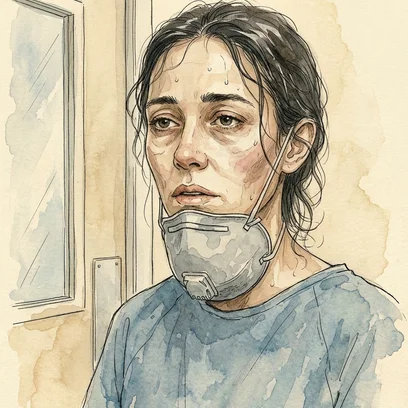
Quarantined Quinn
Tuberculosis: Airborne Precautions, Rifampin and the Orange Secret
Written lecture — video coming
The memory hook
She has coughed for three weeks, lost ten pounds, and sweats through the night — now she lives behind a negative-pressure door
The story
Quinn's night sweats and weight loss were blamed on stress until her chest x-ray. Now the N95s hang outside her door and her urine has turned bright orange.
Quinn was a beloved travel photographer nicknamed Quarantined Quinn by her fellow journalists after she once spent three weeks isolated in a remote research station during a storm, an experience she still jokes about at every dinner party. That old nickname takes on grim new relevance when Quinn returns from a long assignment abroad with a cough that simply will not resolve. Mycobacterium tuberculosis, inhaled months earlier as droplet nuclei, had lodged quietly in her alveoli, where her immune macrophages walled the bacteria off inside granulomas, producing latent infection without symptoms. Now, with her immune defenses weakened by exhaustion and poor nutrition from months of travel, those granulomas begin to break down, releasing active, multiplying bacilli into her airways and turning her once-silent infection into contagious, symptomatic disease.
Quinn presents to the clinic with a productive cough she has endured for three full weeks, drenching night sweats that soak through her sheets, and an unintentional ten-pound weight loss she initially attributed to stress. She also reports occasional streaks of blood in her sputum, which finally convinced her to seek care rather than dismiss the cough as a lingering cold. Her chest x-ray reveals cavitary infiltrates in the upper lobes, and the physician immediately suspects active pulmonary tuberculosis rather than simple latent infection. The clinic nurse recognizes the urgency of this presentation and moves swiftly, placing Quinn in a designated isolation area and initiating airborne precautions before another single person in the crowded waiting room can inhale the aerosolized bacilli she has likely already been shedding for days.
Sputum samples confirm acid-fast bacilli on smear, and Quinn is admitted to a negative-pressure isolation room while her multi-drug treatment regimen is initiated. Her oxygen saturation runs a stable 95 percent, but her fevers continue spiking to 101.8 degrees Fahrenheit nightly, and her appetite remains poor despite nutritional supplementation. Two days into treatment, her nurse notices Quinn's urine has turned a striking orange color, prompting Quinn to panic that something is dangerously wrong with her kidneys. The nurse reassures her this is an entirely expected effect of one of her new medications, not a sign of worsening illness, while continuing to monitor her liver function tests closely given the hepatotoxic potential of another drug in her regimen, and reinforcing that three consecutive negative sputum smears on separate days will ultimately be required before isolation can be discontinued.
The nurse structures Quinn's care around strict adherence and correct isolation practice from the very start. She ensures every staff member entering Quinn's negative-pressure room wears a fitted N95 respirator, while Quinn herself is asked to wear a simple surgical mask whenever she must leave her room for testing. She administers isoniazid alongside vitamin B6 to prevent peripheral neuropathy, monitors liver enzymes given isoniazid's hepatotoxic risk, and counsels Quinn firmly to avoid all alcohol throughout treatment. She explains that pyrazinamide may elevate her uric acid and that ethambutol requires regular vision checks for any change in color discrimination. Above all, she stresses that Quinn must complete every single dose of her six-to-nine-month regimen even once she feels entirely well, because premature discontinuation breeds dangerous drug-resistant strains.
The setup
Quinn has had a productive cough for three weeks, drenching night sweats and unintentional weight loss.
The turn
She is moved to a negative-pressure room. Visitors wear N95 respirators; Quinn wears a surgical mask for her x-ray trip.
The crisis
Quinn feels better after two weeks of medication and asks why she cannot just stop taking four pills a day.
The save
The nurse explains the orange urine is rifampin, adds B6 with her isoniazid, schedules vision checks for ethambutol, and Quinn commits to the full course.
Already a member? Sign in